It is a truth, perhaps less universally acknowledged, that some of the best day trips involve getting yourself completely and utterly lost.
It’s rather difficult to get yourself well and truly lost these days. Our phones track our every movement, our smart watches record our every step. Our friends and family, even if we ourselves have settings switched off, have GPS trackers for their maps, phones mounted in places of honor on the dashboard to make sure that no one makes a single misstep, save for missing an important turn. Even then, the satellites looming high above our heads quickly re-route us, helping us stay the course and finding our destination relatively safely. So much of our ‘spontaneous’ trips are still carefully planned out by machines that sometimes it takes good old fashioned human error to course correct and allow some true spontaneity into our vacations.
Such an instance occurred on the way to the town of Sfakia, by way of the castle Fragokastelo. I was intrigued by story that claimed said castle was the sight of hauntings, but Fragokastelo is a story for another time. For now, it is enough to know that it was enough of an impetus to kickstart a drive to the south side of the island, which I had not explored as fully. A temporary stay at Villa Kastello Kalliste resulted in a new hub for my travels, prompting me to explore the south side of the island with more vim and vigor. Joined by my parents, who had destinations for exploration already in mind, I relinquished control of the car to them and bade them lead the way.
I regretted relinquishing control almost immediately when my family decided not to use my grandfather’s 1997 Honda CRV. Yes, the car was old. So old, in fact, that the ‘check engine’ light stayed illuminated the entire time I drove it, despite having been told that the car drove perfectly fine. The fact of the matter was that the car was perfectly suited for driving in Crete: not too big, not too small, and if you prayed to every god in the Greek pantheon, perhaps you wouldn’t find yourself in a standoff with another car in a tiny village road. The mountain roads we drove through on the southern coast were just the same as on the north side, their width was the same, they were equally well cared for. They also, occasionally, took you through tiny mountain villages – just like the other roads I had become accustomed to driving around, in the notably easier to navigate Honda.
But remember, we weren’t in my grandfather’s car any longer. My parents decided to rent a large, wide truck that in my home country is often referred to as a ‘pavement princess.’ I’m sure they meant well: more room, a working a/c, and not a single dashboard warning light in sight. But as I sat in the back seat of that truck while my father desperately tried to make this massive vehicle squeeze through the confined streets of the mountain towns, I wished, oh I wished, I was back in my old car.
My sister, coincidentally, wished for the same. When the ride simply became too much, my father was forced to find a place to rest for a while. Luckily for us, he found the beautiful gem that is Polirizos Beach.
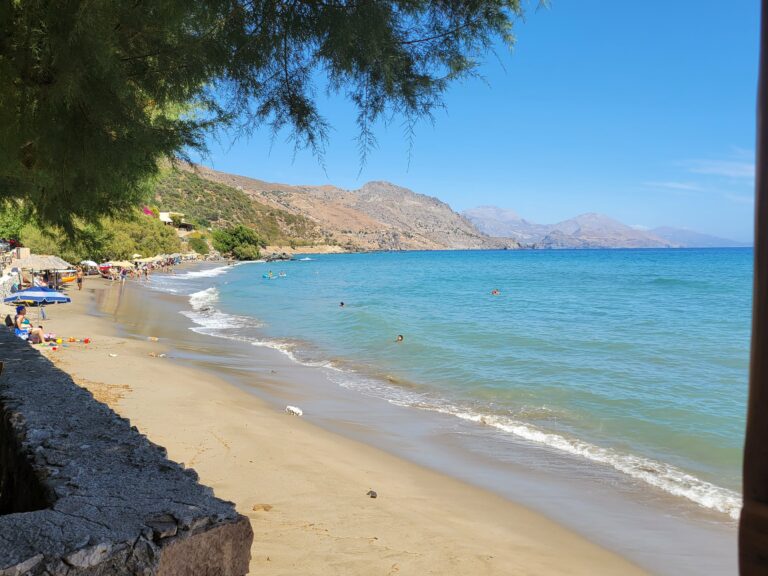
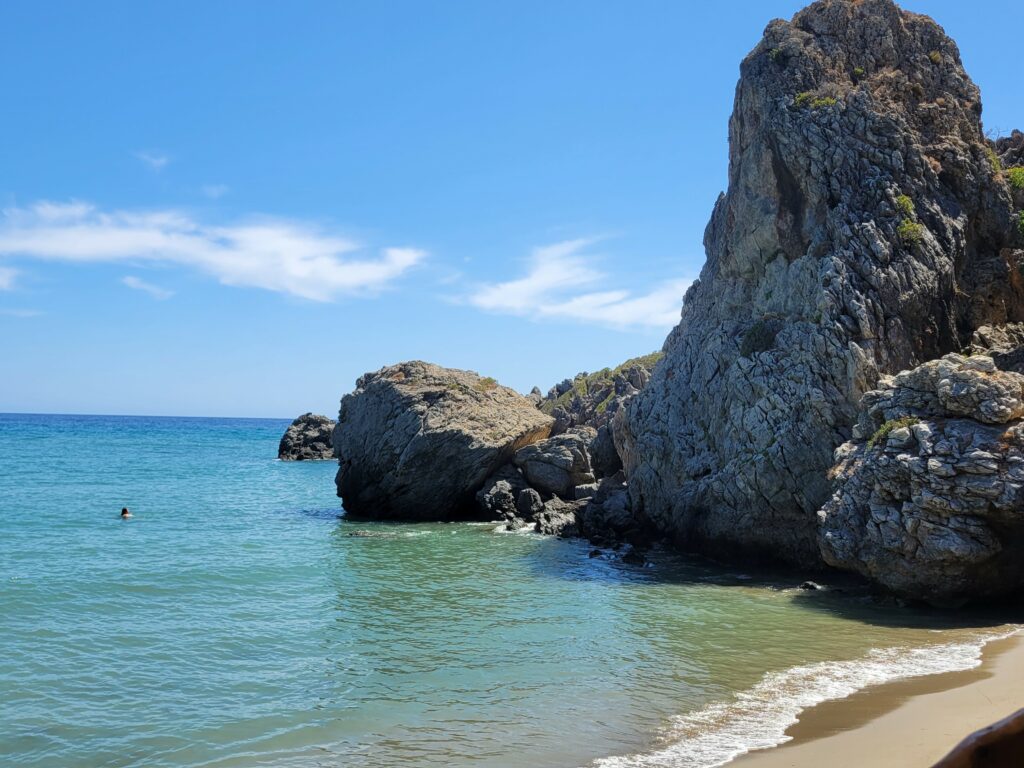
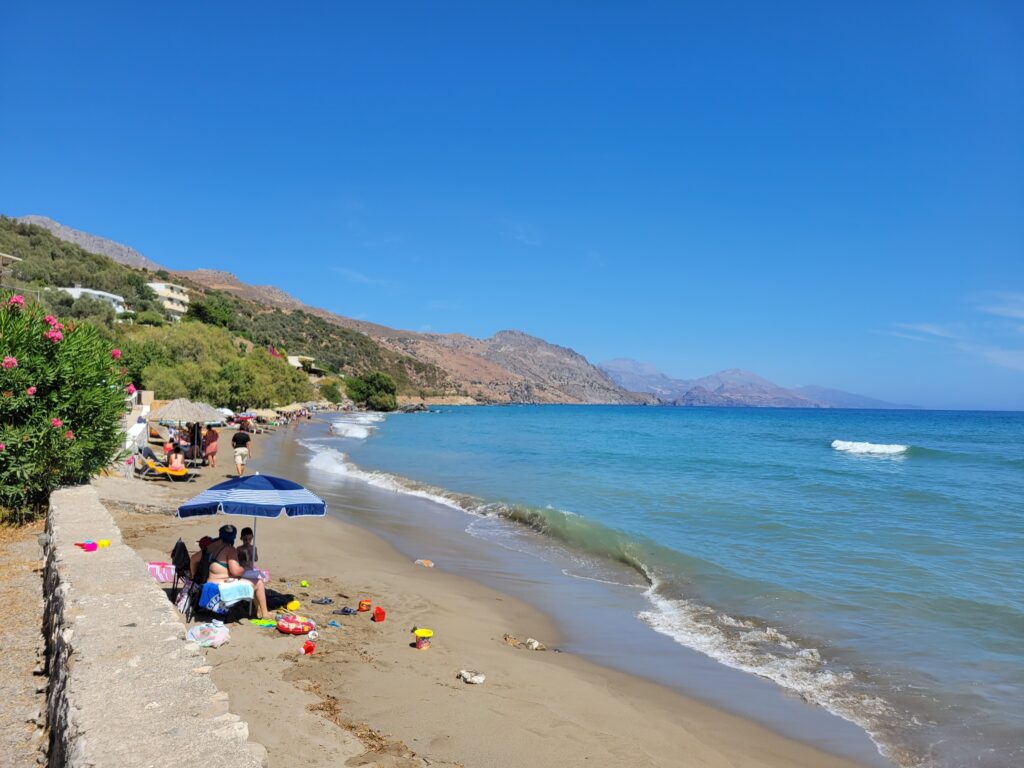
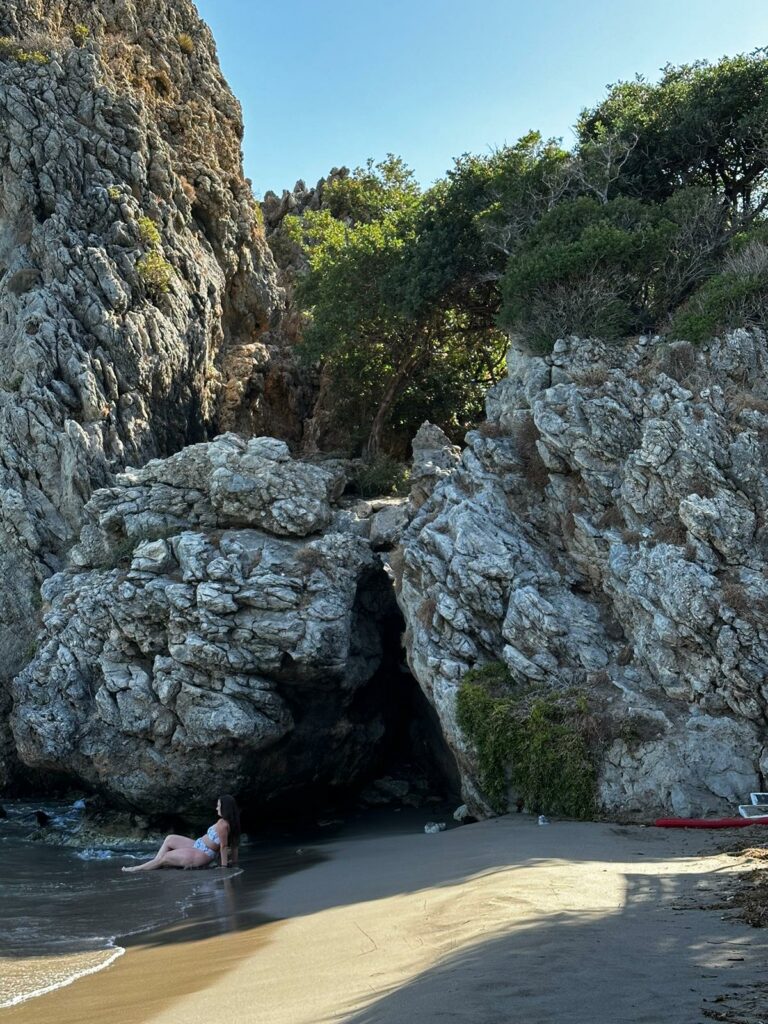
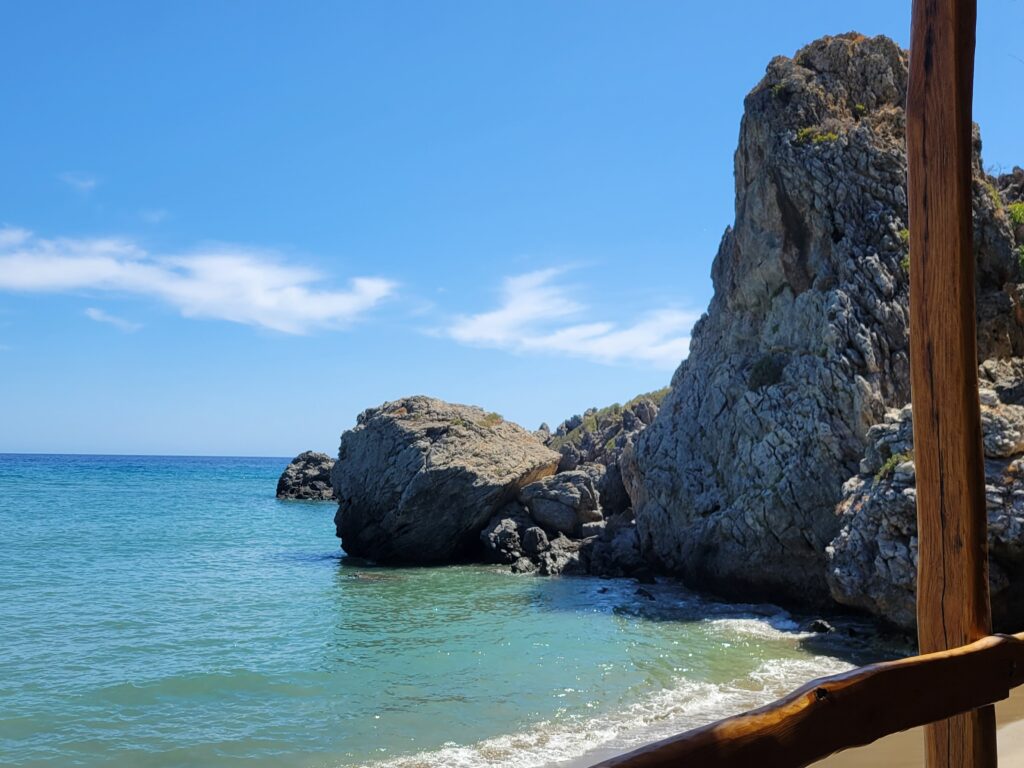
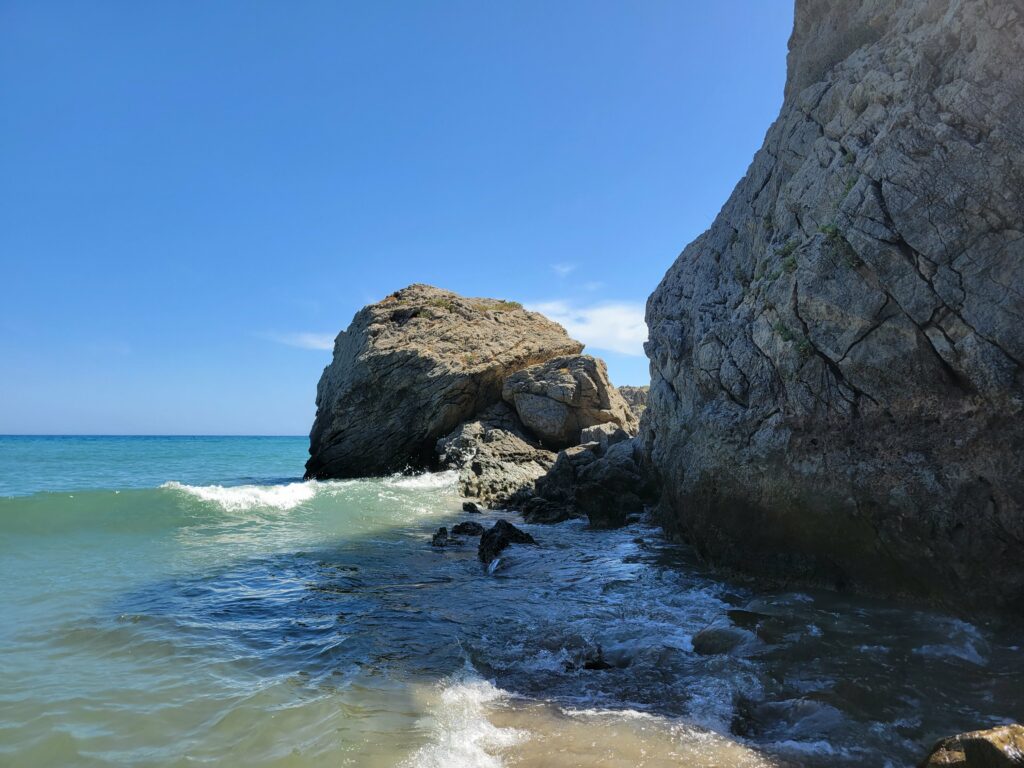
Located in near small village of Rodakino, Polirizos Beach is a small but incredibly beautiful beach that is far less frequented than some of the more well-known tourist spots. Located at the base of the Rodakino Canyon, the beach is home to brilliantly blue, cool, calm waters, and is relatively shallow. The sand is soft and fine, and for most of the beach the waters are easy to stand in and navigate, with only a few (though notable and easy to spot) large rocks that rest under the waves. For the adventurous, there are some large rock faces that aren’t quite big enough to be considered cliffs that can be explored at the eastern edge of the beach should strong swimmers choose to swim around them. I later wondered if it were possible to swim all the way to Fragokastelo, and one day I think I’d like to try it for myself. For the adventurous outdoorsmen and women out there, you could build a hike around ending at Polirizos Beach should you try to hike down some of the gorges that empty out into this area, such as the Rodakino gorge. There’s even a portion of the E4 European Long Distance Path that runs through Crete, (though I think I will leave most of those adventures to hikers more skilled than I).
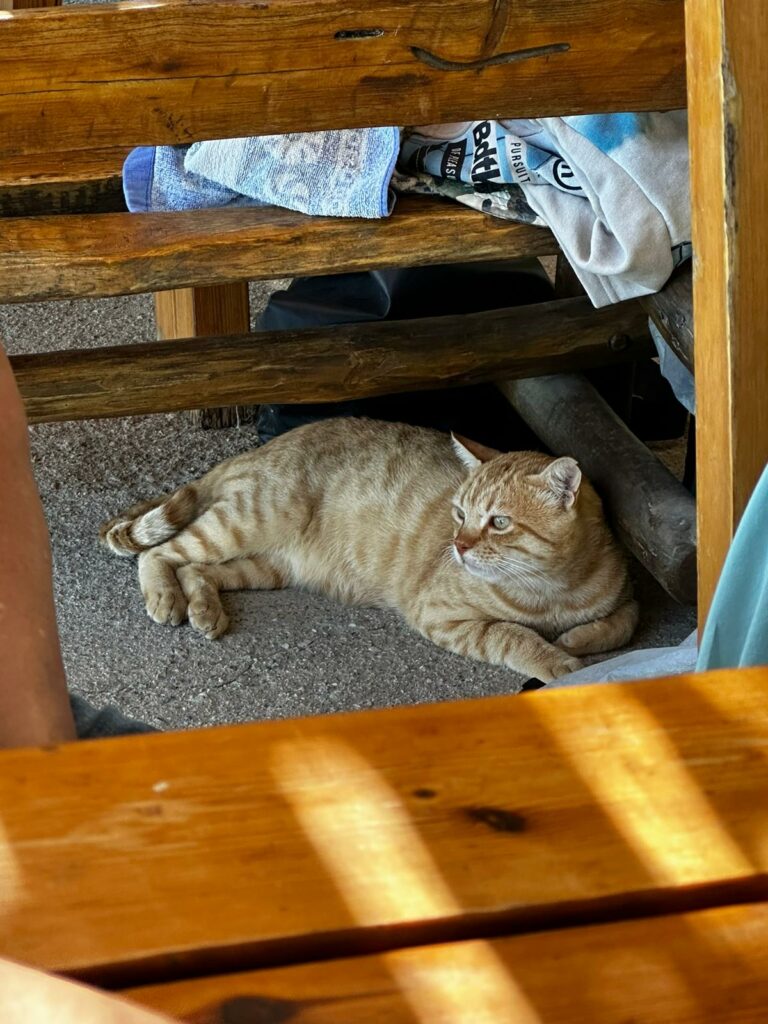
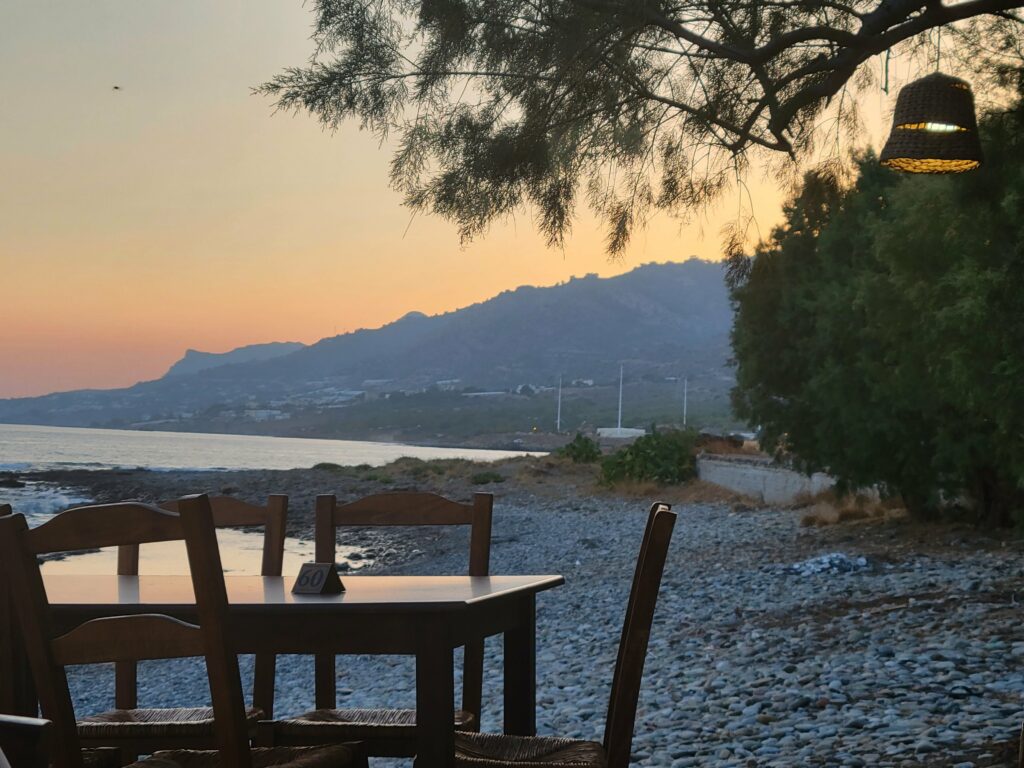
Our band of merry (read: carsick) family members parked in the lot of a delightful taverna named Nikos and Anna, which was attached to a small hotel of the same name. The tables were near an outcropping of rocks that jutted out into the sand like giant bones of a long-dead dragon, at the western edge of the beach. The sound of the sea gently coming in and out, washing over the soft sand beach, was a peaceful soundtrack to an unexpected emergency lunch. My father, trying to make the best of our unplanned interlude, ordered a variety of delicious foods in the hopes that it would cheer the family up. Alas, my mother was not hungry and my sister was violently ill, so they did not participate at first in dolmades or the shared sweet treats that my father and I partook in, the tension of the drive still hanging in the air like the delicious scent of the shared moussaka. It was only when one of the three taverna cats parked himself underneath our table, hoping his adorable face would encourage us to pass him some of the excellent anchovies, that my sister finally felt herself recovering.
As all good tourists in Greece should, we all had our bathing suits on our person. Leisurely and in groups of two (so we could keep our table), we made our way to the beach, lounging in the water and enjoying the contrast of the cool water and hot sun on our skin. I risked swimming beyond the beach and around the corner of the rock faces, tempted to explore the crags and crevices. I instead backtracked to the shore, where some of the rock had formed a kind of cave that inspired thoughts of doorways to fantastical lands. It made for some very entertaining photo shoots I shall not be sharing here.
It seemed to me that this unexpected stop had now become the highlight of our day, and I was tempted to remain on this small but beautiful beach for the remainder of it. However, after spending the majority of the afternoon at Polirizos Beach, we decided to continue onward, hoping to see more of the beautiful island that was Crete. But after that day, we all collectively shifted in our attitude to exploring. We took our time, we let our bodies dictate the pace of our days. And sometimes, but only sometimes, we ditched the GPS to let the winding roads of Crete take us where it wanted us to go.
After all, on an island like Crete, is there really such a thing as a bad day to get lost?
When an autumn holiday is mentioned, one’s mind tends to go towards brightly colored autumn leaves, hayrides, pumpkin patches and hot chocolate. The weather gets crisper, the wind has an almost electric chill, and the promise of a changing season gives people something to look forward to. School is back in session, and many have returned from their summer vacations refreshed and ready to take on the final quarter of the year. But what of those of us who had to suffer through the agonies a summer trapped in our offices? What about those of us who had to work through those warm and alluring months, and now see autumn as our time to carve out the perfect holiday? Did we wait too long for the vacation we’ve been dreaming of?
Absolutely not. In fact, grab those swimsuits and sunscreen: it’s time to explore Crete and Rhodes in the fall.
Fall in the Greek Islands
There is a palpable image many of us have of these islands, the ultimate summer paradise that promises an escape like no other. And yes, one can’t deny the appeal of beating the summer heat with a pleasant day at the beach. However, those who wait until the autumn to travel to the Greek Islands are rewarded with cheaper flights, lower crowds, and an average temperature that, while warm, is much more temperate. Instead of baking in the heat of summer, travelers can comfortably enjoy their days in temperatures of 77° Fahrenheit rather than a dehydrating 90°.
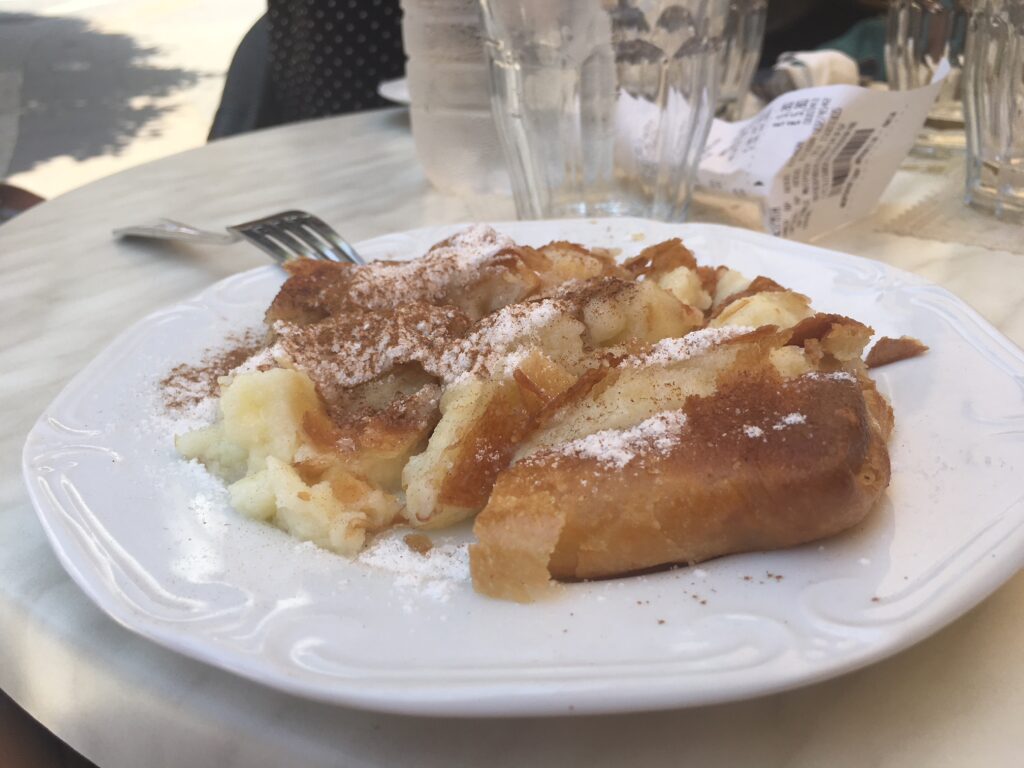
This makes this an ideal time to hike the Samaria Gorge on Crete, or the Butterfly Valley on Rhodes. Instead of suffering a sweltering sun and crowds that could make these outdoor activities more of a trial than a pleasure, lovers of the great outdoors can explore without as great a fear of heatstroke. The water is as cold as ever, but the days are still warm enough to keep the bikinis easily accessible, so long as a thin sweater is in your bag for the late evening. Wandering around monuments, such as Rhodes’ Acropolis of Lindos or Crete’s Palace of Knossos, become much easier to navigate in a kinder sun. Indeed, Crete in the fall is like a paradise: the city of Heraklion is far less crowded out of season, and getting a table at your favorite restaurant is far easier than it was only a few weeks before. There’s nothing quite like enjoying some autumn bougatsa at Philosophies, sitting outside as the slightly cooler air leaves for a much calmer people-watching experience.
The Fall Festivals of Rhodes
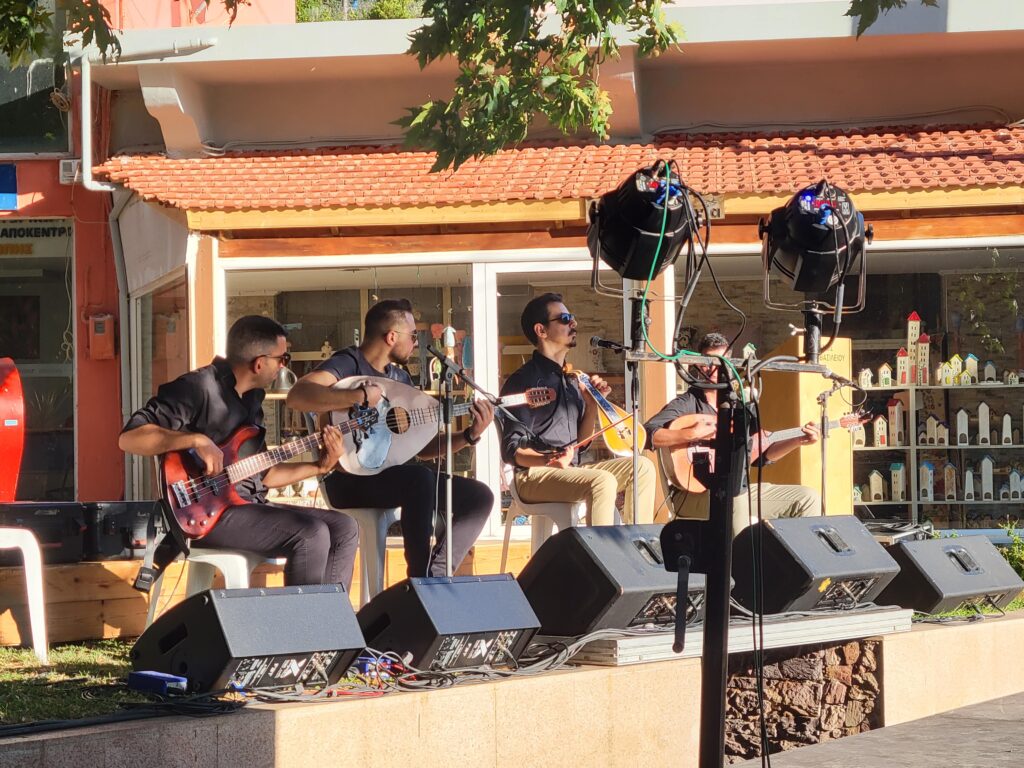
There are also special festivals that travelers can’t experience at any other time of the year. On the island of Rhodes, the end of September ushers in the European Polyphony Festival, an artistic festival celebrating “classical music, visual arts, and cinema.” This twelve-day festival boasts showcases of different visual mediums, such as photography, sculpture, and film, as well as various musical concerts, parades, workshops and lectures. It is certainly the artistic event of the season on the island, and those who are patrons of the arts should be sure to make the pilgrimage.
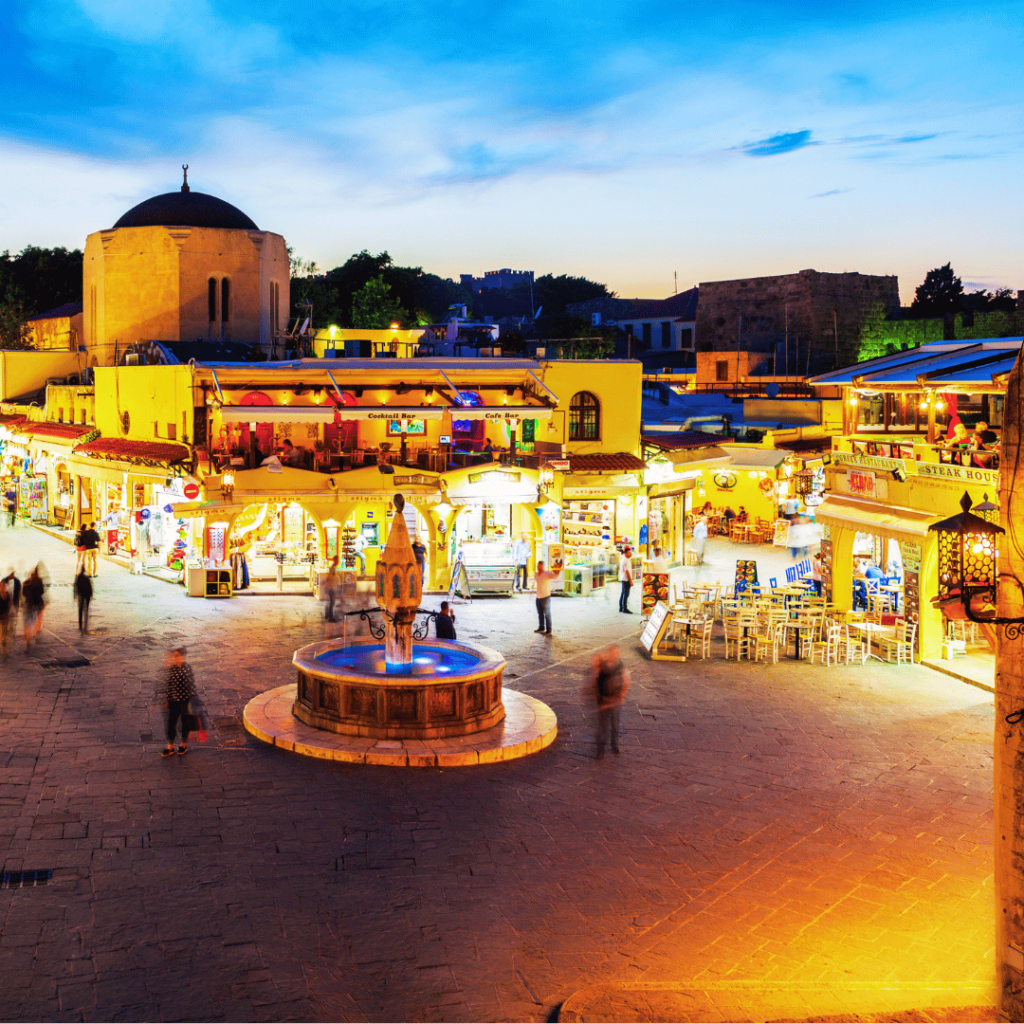
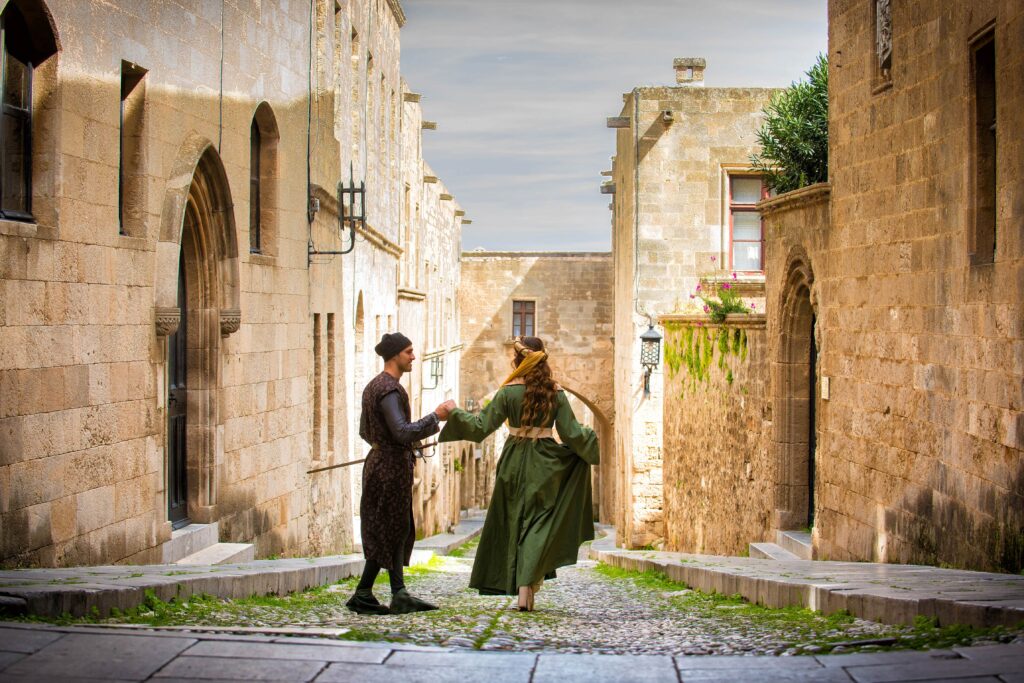
For fans of medieval history (or some fun fantastical role-play), there’s also the Medieval Festival of Rhodes in October. The dramatic setting of the Old Town, replete with immersive architecture that sends travelers hurtling back in time to the days of knights, witches and dragons. The festival has exciting workshops that illustrate life back in the day of the Knights Templar, such as mosaic art, pottery, woodworking, grass rope making, and even workshops to demonstrate how to make a silver coin. There are performances of medieval Grecian music, plays, storytelling events, and opportunities to learn medieval games with those who have studied them, (or at least to brush up your chess knowledge). The piece de resistance is the Chase of the Dragon, where three teams of lucky applicants re-enact the legend of the Dragon of Rhodes, who was said to have lived on St. Stephanos cliff. This mighty dragon allegedly terrorized the townsfolk of Rhodes who lived on the island during the 14th century, until it was slain by Dieudonné de Gozon, Grandmaster of the Knights of Rhodes. The teams participating in the Chase of the Dragon will work together to solve riddles, uncover the dragon’s path, and engage in general questing knight behavior. Of course, those of us English speakers are advised not to participate without a Greek speaker, but all ages are welcome to apply. What better way to usher in October than by chasing a dragon?
The Fall Festivals of Crete
On Crete, festivals of a different kind are taking place. Autumn is a time of harvest, and the most popular way to celebrate grape harvesting is with the Kazanemata, or the Cauldron Feasts. Also known as Kazania, this autumn festival is when Cretan farmers distill their famous Raki in the copper cauldrons necessary for the lengthy process of turning grapes into liquor. Though this festival takes place in November, a time when a chill has finally started to settle over the island and rainy days are more commonplace, the event is not to be missed should you want a real insight into Cretan culture and life.
There is also the Elos Chestnut Festival, which takes place in the Cretan town of the same name. This festival date changes every year, so there is no real way to give you a decent time estimate as to when you should plan your trip except for roughly October/November. If you are lucky enough to make it to the Chestnut Festival, you’ll join a lively party with singing, dancing, and of course, lots and lots of chestnuts. No one celebrates a good harvest quite like the people of Crete, so if you are lucky enough to find yourself in Crete on those days, you should prepare to celebrate.
Dreams of Autumn
Autumn is an oft overlooked but magical time to be in the Greek Islands, especially if an overcrowded, hot, and hectic summer isn’t what you had in mind for your ultimate vacation. While everyone else is preparing for hayrides or a new school year, maybe this is your time to experience a paradise in a whole new way. Will you hunt for dragons in the streets of Old Town in Rhodes? Take part in the Kazanemata with the farmers of Crete? Or will you explore these islands to your heart’s content, with less crowded streets for as long as the sun keeps shining?
Maybe it’s time you dreamed a little bigger for your autumn vacation.
One of my favorite things about going to Crete is the grand variety of caves. This may come as a bit of a shock to those who know me best, as I make no pretense about having a healthy respect, (i.e. a borderline fear) for caving. Nothing gives me pause quite like the thought of finding myself wedged between a small gap between two rocks miles and miles under the dark, damp earth. However, the cave experiences I’ve had in Greece are the kind that are walkable and open, and dare I say ‘breathable.’ In Crete, I can act like a tourist paying my respects to the bowels of the earth, a visitor who dips their toes into caving without the risk of bodily injury. It is a quintessential outdoors activity.
There’s no greater place to enjoy some ‘relaxed’ caving than Crete. The island is dotted with so many wonderful places to explore, and I’ve already touched on one of the best-known caves, Diktaion Andron in the Lasithi Plateau. All of the caves on Crete are seasonal; they open in April and close in October, as the rains and snow make exploring the caves too dangerous. But once spring rolls around, tourists like me are free to explore these natural wonders. Some of these caves have guided tours while others are self-exploratory paths. These caves are protected as national monuments by the Greek Government, so if you choose to visit these caves, it’s best to go in with a respectful mindset, of not only the rules that are in place to protect the health of the cave, but as well as the history it represents.
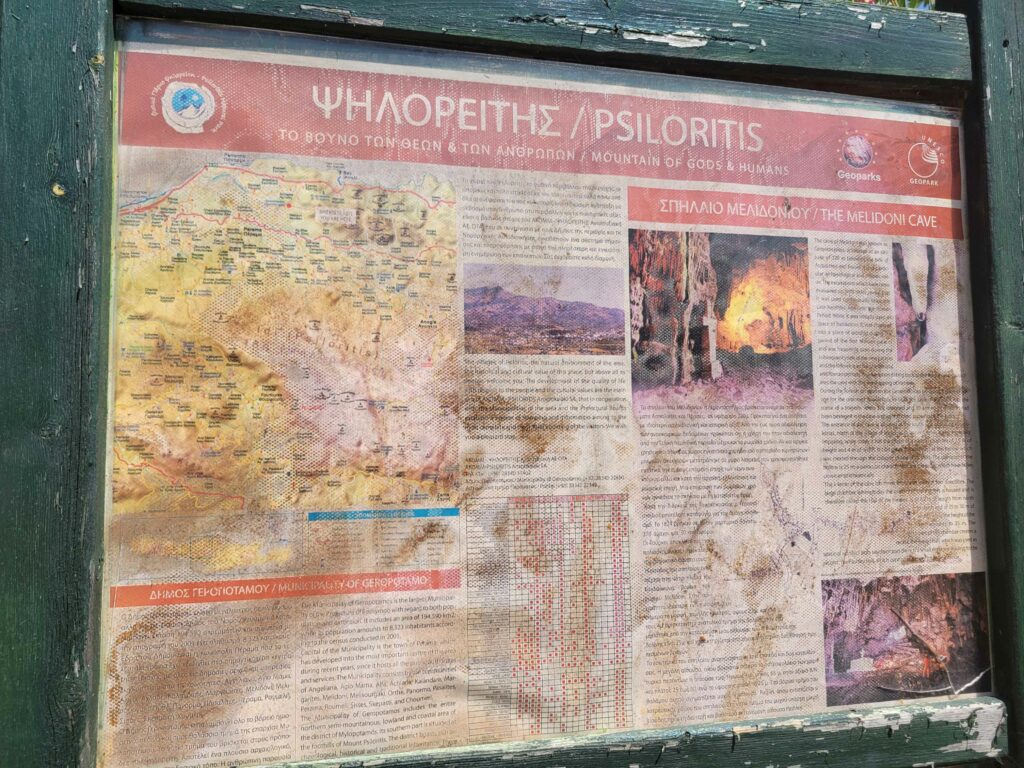
This brings me to the beautiful Melidoni Cave, which can be found on the way to Rethymno and 1800 kilometers from the village that shares its name. Should you decide to go, I would advise you to be careful on the way to the village and take that last stretch of the A90 slightly slower so you don’t miss the turn, and be forced to drive your slightly-too-large grandfather’s car through the streets of tiny villages that aren’t your destination. If you miss said turn, which I must admit is easy to do, you can trust the maps to redirect you and perhaps see a lesser explored part of Crete. Passengers who accompany you, however, will be more prone to screaming if you happen to follow the GPS through a tiny village with even tinier side streets. As your side mirrors are pushed inward, the village cats watch you with a mixture of caution and disdain from the steps of homes you are praying your car is thin enough to squeeze between.
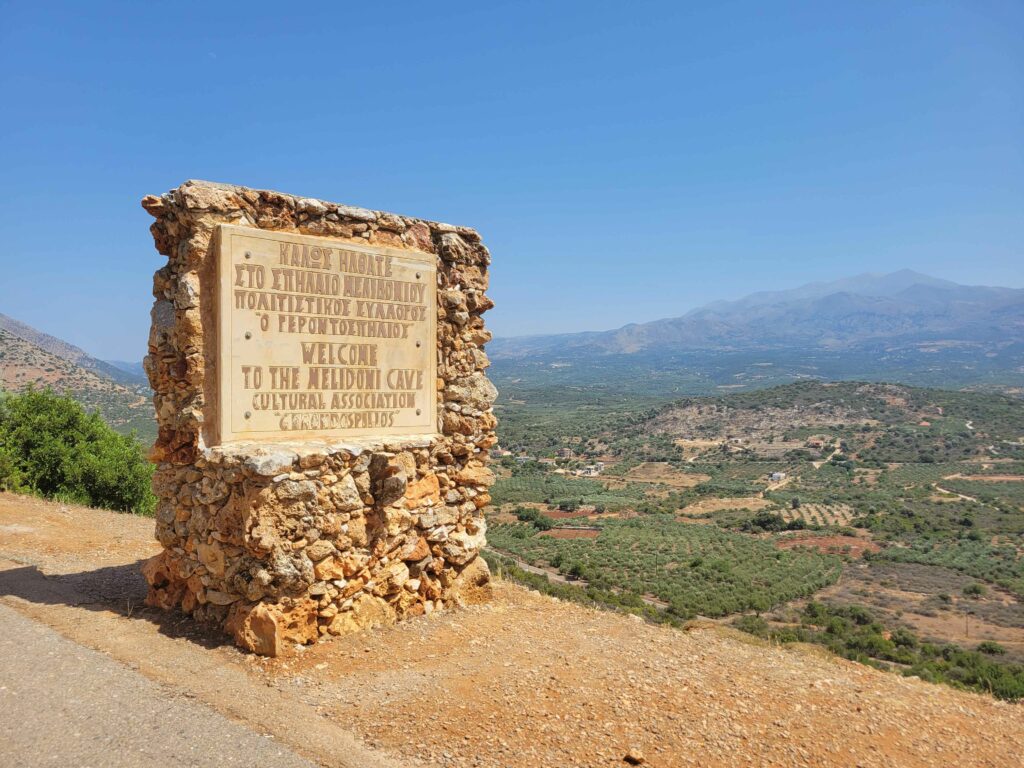
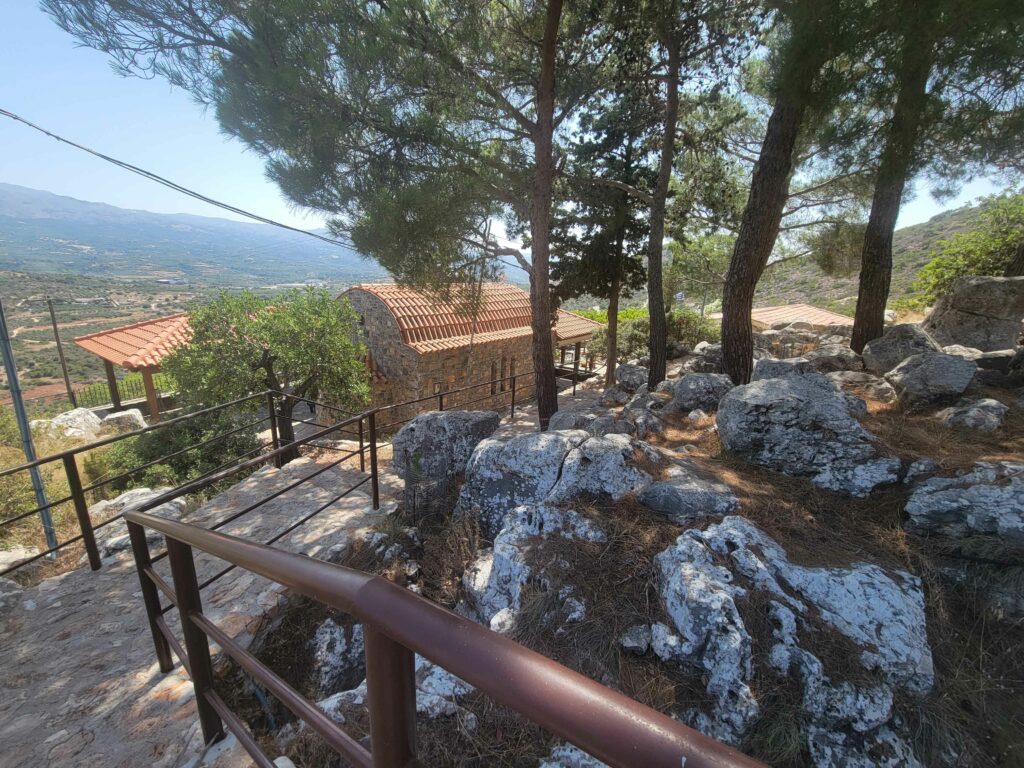
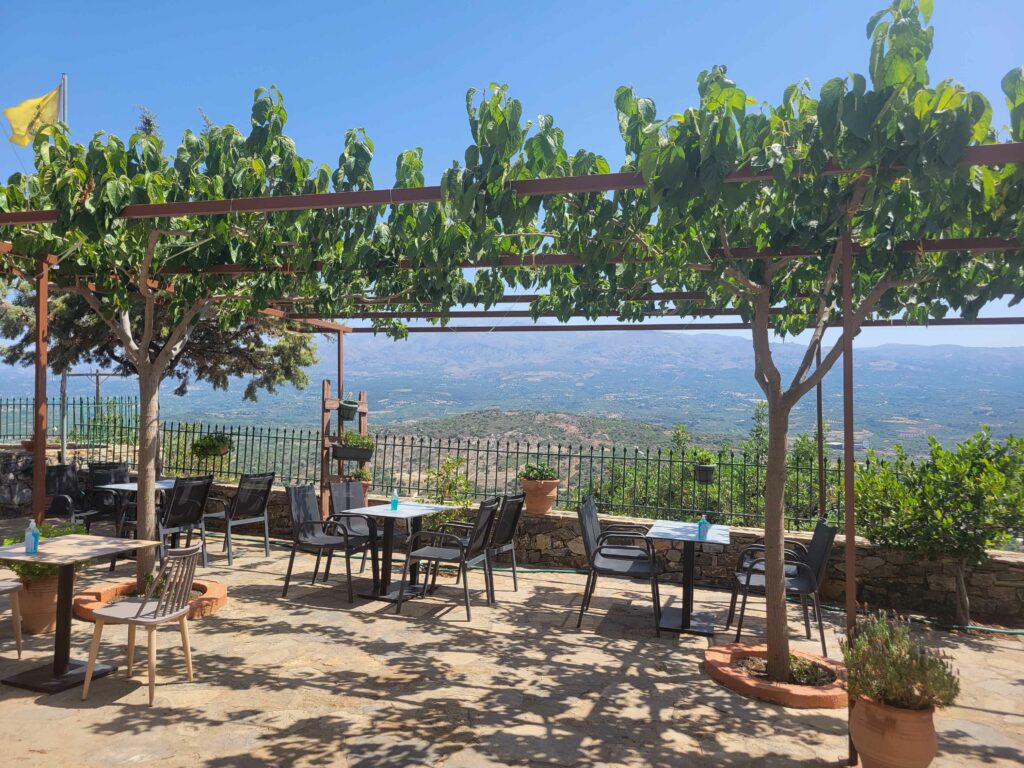
This may surprise you, but it was I, gentle reader, who found myself wedged in that uncomfortable predicament. If Melidoni cave was one of those caves in which explorers had to wedge between rocks, I might have taken my mistake as an ill omen, but I followed the road safely out of the small villages with little to no discomfort. Using the GPS with slightly more attention, I found my way to the town of Melidoni without incident, relishing normal roads. The 2km road leading out of town and up the mountain to where the cave awaits is a beautiful expanse 200km above the valley, which results in a splendid view the entire valley, which in the spring colors the valley in flowers that disappear come the summertime.
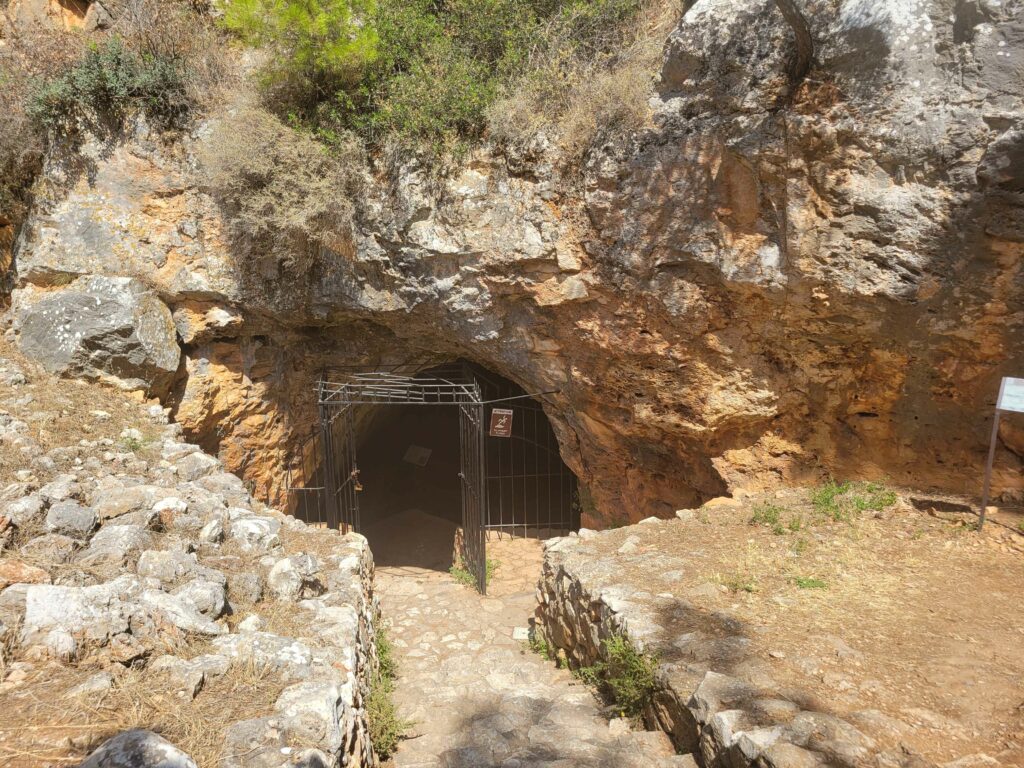
All one must do upon their arrival is pay the €4 ticket fee (€3 for children) to enter into the garden path beyond the café. I took my time on the short walk up the path to the mouth of the cave, savoring the dappled light that filtered through the tall trees that rustled softly in the breeze. It felt, to me, like it was the last kiss from the outside world before I descended into the mouth of the cave. As I neared it, the path in question became less woodsy, as if the last concentrated area of sunlight was something I was meant to savor before my descent.
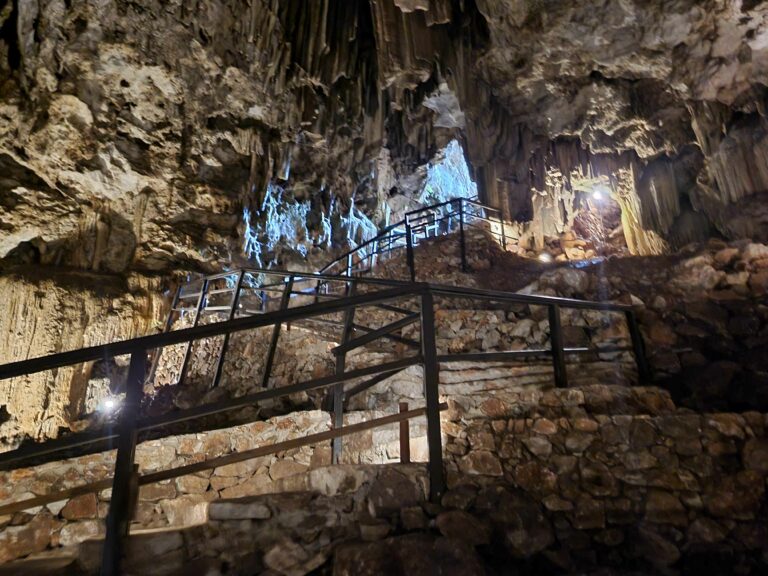
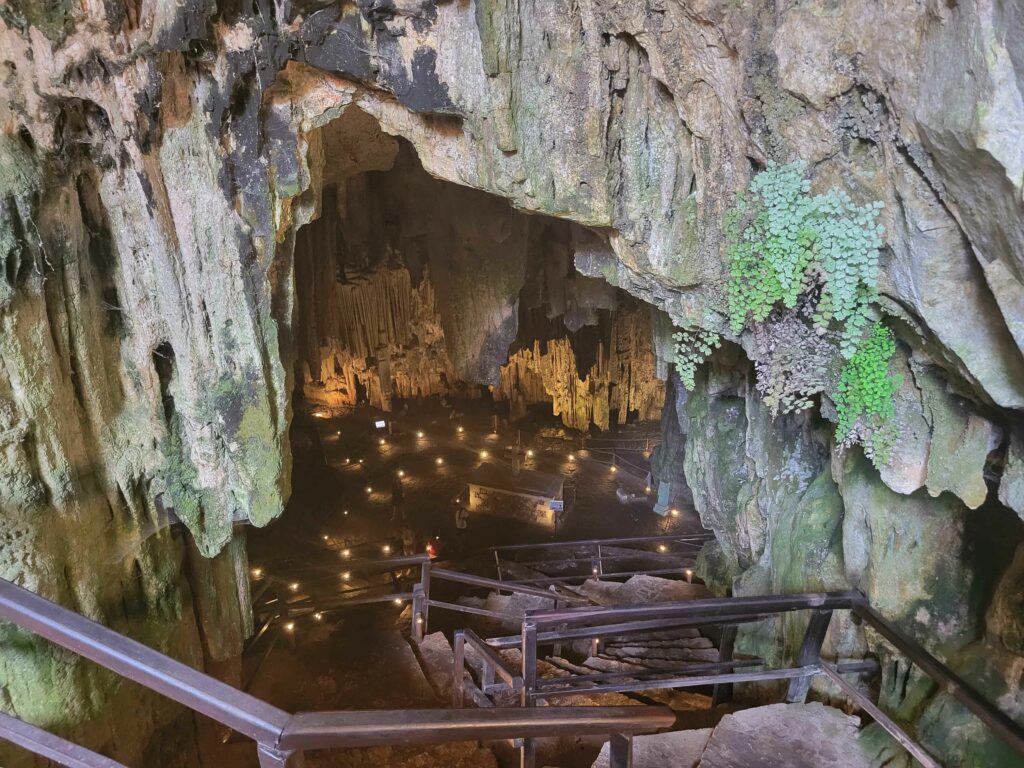
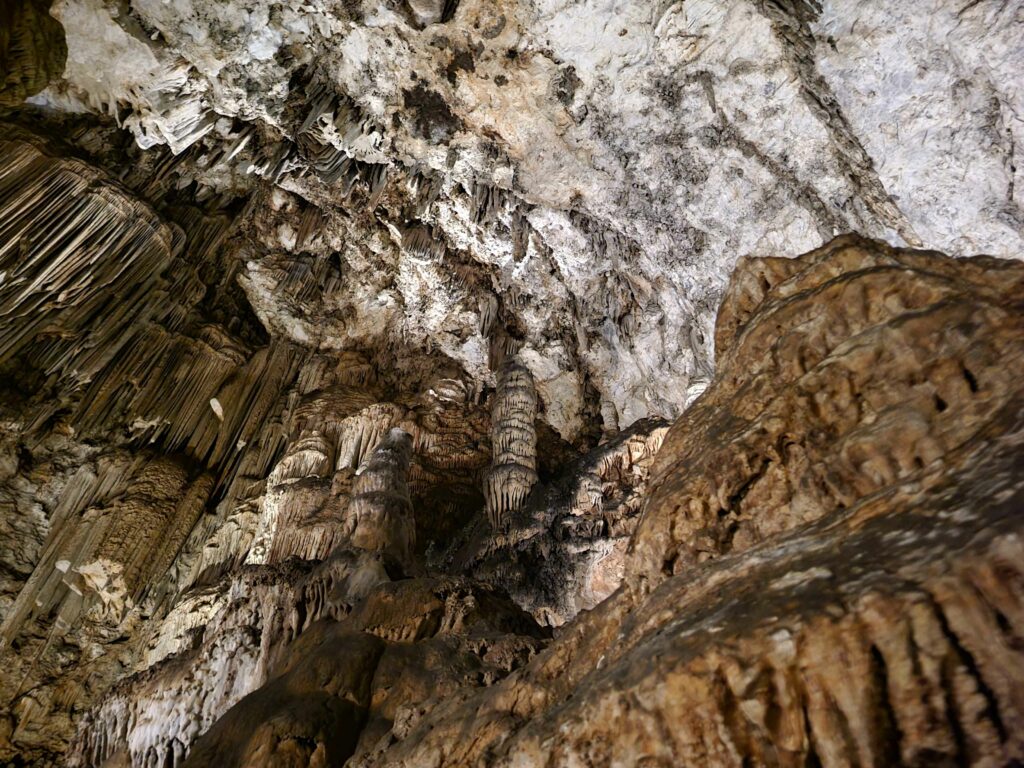
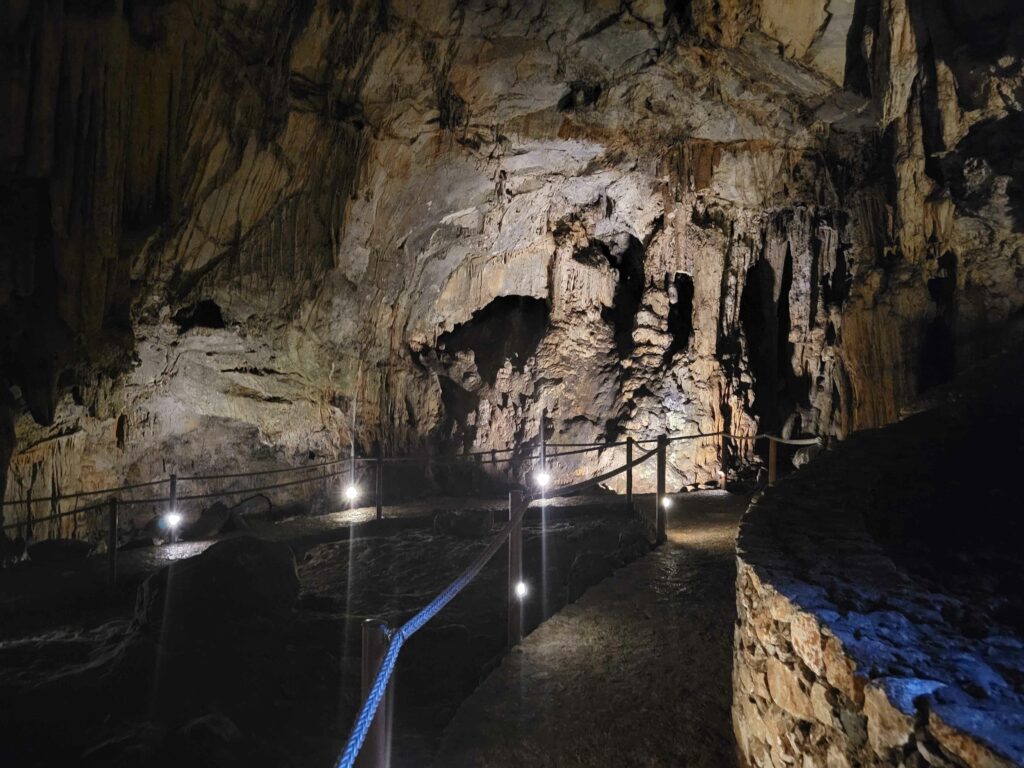
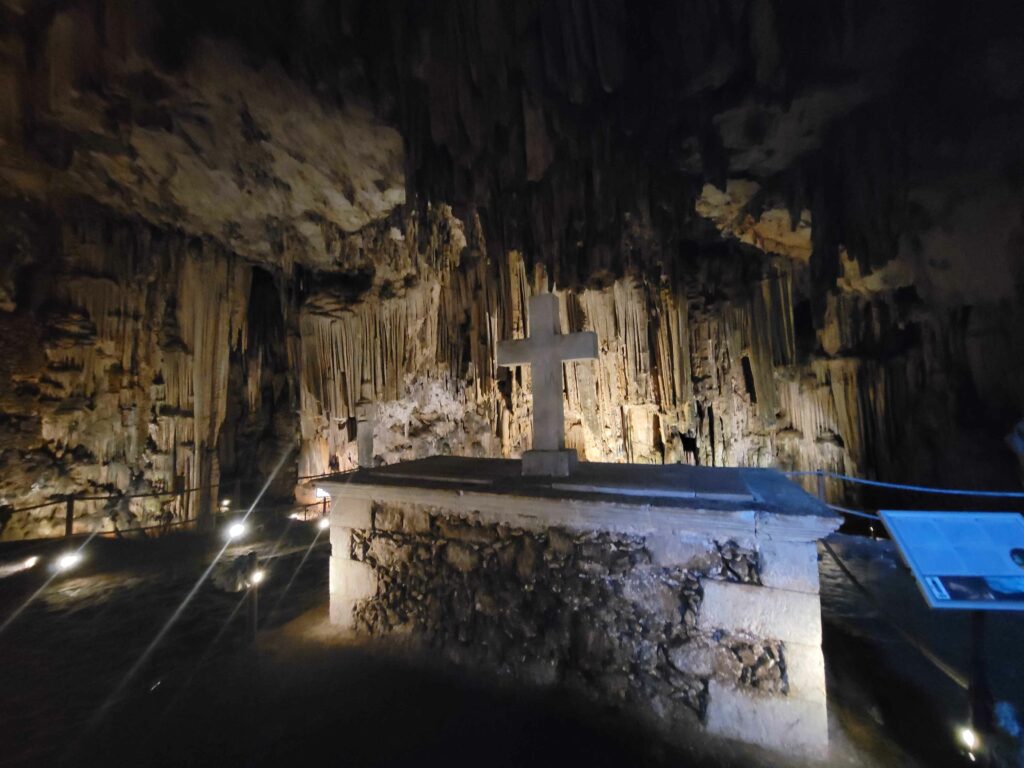
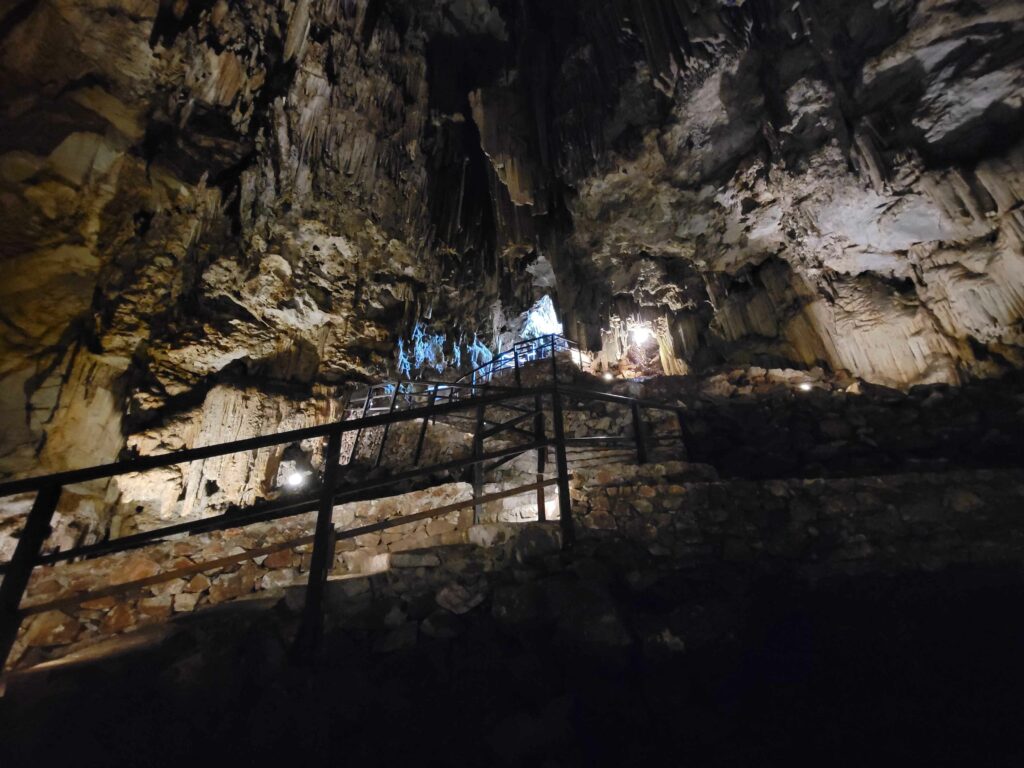
The stairs in Melidoni Cave were very well managed, and not nearly as steep or long as I have experienced in other caves. It was, in fact, one of the safest set of stairs I’ve been on when entering a cave in Crete, and though I took my time, I felt sure-footed most of the way down. I went to visit the cave during the height of summer, so the drastic temperature change from almost 100°F to roughly 75°F was a welcome relief from the Cretan sun. The stairs led right to an almost cathedral-like main room with an altar right in the center of it, stalactites hanging from the ceiling in in an arch-like fashion that only added to the majesty and imperial nature of the cave. All along the floor were small electric lanterns that gave the place the sensation of being inside a chapel rather than in the bowels of the earth, and a reverential hush fell over all of us who entered. I decided to explore the surrounding walkways before making my way to the obvious focal point of the stone altar, and took the pathway to my right.
If you check the website for the cave beforehand, you’ll see many references to the worship of Talos. For those not in the mythological know (or those who never say Ray Harryhausen’s depiction of him in the 1963 version of Jason and the Argonauts), Talos was an automaton crafted by the god Hephaestus. Made entirely of bronze, it was said that this giant robot served as protector to the island of Crete, and was worshipped by the ancient Minoans. This was when the cave was known as Gerondospilios, rather than by Melidoni.
Of course, the cave served many purposes besides a meeting place for the worship of Talos. All along the cave walkways were informational plaques that told of the vast archaeological discoveries within the cave. The people of the bronze age used to use caves for refrigeration, storage, cooking, and shelter, and so many bronze age artifacts were uncovered here. Most of the artifacts are on display in the nearby archaeological museum of Rethymno for the public to view. The cave also has a distinct tie to the worship of Hermes, as inscriptions (i.e. ancient graffiti) on the cave wall make reference to the cult of Hermes, even up to the period of venetian and turkish rule of the island. The cave calls these inscriptions the ‘book of visitors,’ as many who came to pay respects left their names upon the wall. Worshippers seemed to address the messenger god as Hermes Talaios, though I am unsure as to why he received the additional moniker.
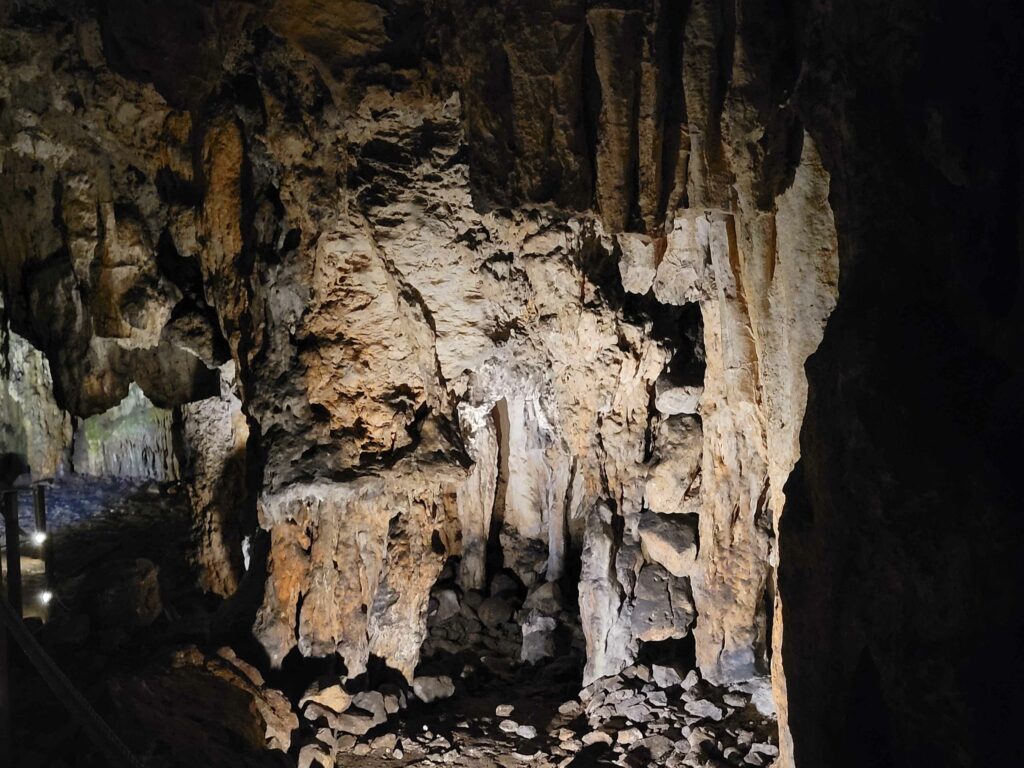
Following the pathway around the ‘Room of Rocks’ and towards the ‘Stone Curtain,’ I slowly made my way back around to the initial room, marveling at how the carefully placed lights made the room such a hauntingly beautiful place, the shadows against the stone walls resembling a kind of drapery. Finally, I was ready to approach the altar that served as the focal point of the cave, and read the plaque that told me why such a thing existed inside the cave. It was not, as I had first assumed, because the cave had been used as a place of worship: it was, in fact, a place of refuge. In 1823, during the war for independence from the Turkish forces, 370 women and children, as well as 30 resistance fighters, ran to Melidoni cave for refuge from Hussein Bey, the leader of the Ottoman forces at the time. The escape plan resulted in those 400 people becoming trapped inside of Melidoni cave with nowhere to run, which was good news for Hussein Bey; if he could starve them out, he would get a complete surrender, dealing a blow to the resistance movement. The problem, of course, was that he was dealing with the people of Crete: their answer to his request was “Death, no surrender.”
Hussein obliged. He ordered his troops to light fires at the cave entrance and then blocked it off, sealing the people inside with no oxygen and a growing, suffocating cloud of smoke. All 400 people perished within Melidoni Cave, perhaps, I realized, on the very ground I had been walking on earlier. Egyptian troops, whose stake in the war was to assimilate Crete into Egypt, arrived days later and desecrated the corpses. However, the bodies of the fallen resistance leaders and the 370 women and children were cleaned, and their bones were put into the ossuary that I had originally mistaken as the central altar.
The stone above me, in front of me, below me and to all sides suddenly felt a little too close as I imagined this being a final resting place. With the lights in the floor and the sunlight leaking through the mouth, the cave was beautified, almost peaceful. I tried to imagine it dark, with the doors closed to me, with smoke filling my lungs. It was not so peaceful then. But I suppose that is the power of memorial: we take the places of great tragedy and turn the wounds of the earth into scars, as healed as we can make them. We try to give those who perished alone and afraid into a place that they might find restful. We leave on the light in a place where women, children, and fighters died alone in the dark. Maybe it isn’t much. But the quiet reverence of the cave, palpable from the second I set foot on the stairs, was perhaps the only way left to visitors like me to honor them.
I made my way out of the cave, like Orpheus departing from the underworld, step by step. Like Orpheus, I turned to look back one final time before I had made it completely out of the cave, staring at the altar in the dark as it was gently lit up by the lanterns on the floor of the cave. I thought about those who could not leave, and all the visitors across millennia, like myself, who could. I thought about how this cave had been in the service of this island for thousands of years, and how even now it served us by teaching us about those who came before, those who used the cave as a place of worship, comfort, and all the aspects between life and death. I passed out of the cave and into the sunshine once again and breathed in deeply. The air was sweet and hot and I was glad of it all.
I thanked the cave for all that it had been, and left to see what else the day had in store for me.
The coming of the New Year is usually a time where we resolve to make changes in our lives. We make plans to lose weight, travel more, dedicate more of our limited time on earth to bettering hobbies or seeing more of our friends and family. Maybe we want to call our mothers more, or our fathers, or maybe we want this year to the year where we finally write that book. But while naysayers may say that the new year serves only as an arbitrary day of self-imposed change, sometimes government agencies make changes for us.
Welcome, fellow travelers, to 2025: the EES and ETIAS seem to (maybe) be upon us.
What is the EES?
The EES and the ETIAS are new travel requirements that have actually been in the works for several years for entry into the European Union. The EES, or Entry/Exit System, is meant to automate and eventually replace the passport checks that Non-EU citizens face when entering or exiting. For those of us who are traveling for short stays, as defined by the EU as up to 90 days within a 180-day period, we’ll have to contend with this new system.
The EES is meant to automate the entry and exit process by collecting biometric data, when we enter and leave the EU, the data already in our passports such as our date of birth and the passport’s date of expiration, and whether or not we’ve been refused entry into the EU. The EES is also supposed to replace the standard passport stamping, which will surely be a blow to everyone who, like myself, enjoyed collecting stamps from their travels. While the idea of biometric data being collected is not exactly thrilling, the EU is implementing this new border system in order to catch people who overstay their welcome in the Schengen Area without the proper paperwork, such as a work visa, and to prevent potential identity fraud.
There is currently not a set date for when the EES will be implemented, though some speculate it will kick off during the late spring or early summer. However, there is a firmer date for the next travel requirement: six months after EES begins, the ETIAS goes into effect.
What is the ETIAS?
The European Travel Information and Authorization System is a new travel requirement that any future visitors must apply for. For countries that do not need a full-blown visa to travel to the EU, such as travelers from the United States, future tourists will now need to apply for an ETIAS waiver in addition to having their passport handy.
It’s best to apply for the ETIAS waiver as soon as you know you want to travel, have a business trip on the books, or are traveling for any medical reasons. Though it’s easy enough to get your ETIAS approved, there’s always a chance that due to errors in the form (or for any reason) that the request will be rejected, and the last thing you want is to be stranded at the airport. Once your waiver is obtained, you’ll be able to access any of the countries in the Schengen Area while you’re traveling, and lasts for 3 years unless your passport expires before that date. As the ETIAS is attached to your passport, you have to make sure that your passport isn’t on the verge of expiring before you apply.
What do you need?
Right off the bat, it’s important you know one thing: it does indeed cost money to obtain an ETIAS waiver. However, unlike a travel visa that costs around €80, the ETIAS form costs only €7. It’s also important to note that you must fill out a form for every individual traveler, and that if you are yielding that responsibility to someone else, there is another form that you must sign that shows you are allowing that third party to handle your waiver application process. Even if you are applying for a minor, you still need to fill out that form. This is good to know should you desire to have your travel agent handle all this paperwork for you.
As to what you need to fill out your own form, you’ll need your personal information: name, date of birth, nationality, your email, and phone number. You will also need the names of your parents. You’ll need all details from your travel documents (i.e. your passport), and need to list your level of education and current occupation. You’ll also need to list why you’re traveling, such as whether you’re traveling for business or for vacation, and any criminal history you may have. Now, if you’re like me, that can all sound a bit daunting at first. After all, that’s a lot of information and more paperwork for you. However, if you know for sure that European travel is in your future within the next three year period, it’s a good idea to fill it out as soon as possible so you don’t need to worry about time crunches. The good news is that approval usually takes up to 96 hours, and sometimes yields results quicker than that.
When does this go into effect?
That’s an excellent question that, as of January 2025, does not have a clear-cut answer. This project has been pushed back several times over the years, and was most recently delayed from its initial launch in 2024 as several key nations felt they would not be ready. However, they are insistent that 2025 is the year this all changes. So what do we need to expect?
For now, we are still waiting on the EES to be implemented. Once that begins, there will be a six-month grace period where travelers will not need to fill out paperwork for an ETIAS waiver. However, once that six-month deadline has passed, we will officially have new European travel requirements. Until the EES is officially debuted, however, you can continue to travel as you have in the past.
Don’t Panic
The most important thing to remember when planning your trips going forward is that all of this, while perhaps an additional hassle, is not a substantive barrier to travel. As troublesome as additional paperwork can be, obtaining your ETIAS waver shouldn’t be too much of an impediment to your spring, summer, fall, or even winter vacations to Greece or any of the other European countries. For my part, I’ve put it in my calendar alongside my passport renewal date, and consider it the price of a nice Greek Islands summer, (even if I would rather not). As long as it stays on the travel checklist, vacationing in Europe should still be as easy as pie.
It has been famously stated that, while ‘poems are made by fools like me/only God can make a tree.’ This is a truth so obvious it almost doesn’t need to be said. I, ever the poet, languish on my silly little travel blogs while God divinely calls forth mighty oaks from saplings, or great pine trees from tiny cones. I’m not envious, really. He sticks to what he does best and I stick to what I do best and we all get along swimmingly. As a result of the divided labor, however, trees were never at the forefront of my consciousness.
That’s not to say I never spared any of my thoughts for the trees. In my youth, my father spent a great deal of his time (and, as a result of my status as child, my time) at plant nurseries, finding the most beautiful trees to plant and rear with love and care in our growing garden paradise. While I was supportive of this in the abstract, I had no real desire to join my parents in the hard work of actual gardening. In my mind, the Florida sun was only fun if I was at the beach, a theme park, or doing some sort of activity that was catered to…well, me. Though I was often enlisted to assist against my will, nothing about hard work in that heat appealed to me. While I can look back on those memories with a relative fondness, today I am content to live in an apartment where I barely remember to water my little cactus once a month.
My childhood instilled in me a respect for trees, even if I don’t go out of my way to cultivate a green thumb. I’ve helped plant them, I’ve harvested fruit from them. I’ve watched my parents work tirelessly to attempt to save sickly ones, transplanting trees delicately from one part of the yard to the other in an effort to give it more sun or more shade. I grew up with the constant reminder that deforestation was a legitimate issue, with campaigns to save the rainforest everywhere there was an iota of environmental awareness. Save the Trees! Plant a Tree! Hug the Trees, Kiss the Trees, Speak for the Trees! Trees faded into the background of my life as a nice thing to appreciate during walks in the evening or strolls through a botanical garden, but they did not occupy much space in my thoughts besides. They gave me oxygen, I took them for granted. But on the island of Crete resides a very special tree. I had heard about it in passing, a small factoid dropped in an otherwise casual conversation, but it struck me as such an odd thing to consider ‘casual.’ To be told that one of the oldest living trees in the world currently lives and breathes only 146 kilometers from the villa you’re vacationing in sounds like a bombshell. Something about being in the presence of a practical immortal filled me with curiosity, and I made a point to see with my own eyes the Ancient Olive Tree of Vouves.
The Olive Tree of Vouves is not, as I first thought, the oldest living tree in existence. This honor belongs to Methusela, a Great Basin Bristlecone Pine tree that resides in the White Mountains of California. If we factor in the different types of trees such as clonal colonies, angiosperms, gymnosperms, and a million other words that I learned just to write this cursory sentence, you’re going to have a difficult time narrowing down just which tree you want to visit. But the Olive Tree of Vouves is estimated to be the oldest living olive tree, and on a place like Crete, that is no small thing. Olive trees are nourishing. Their fruit has sustained civilizations upon civilizations, from the days of the Minoans to the modern day. Their wood is beautiful, and when treated right, makes furniture that lasts. Their branches have come to not only represent victory, such as when crowns made from their branches were woven into crowns during the Olympics, but also as a symbol of global peace. Of all the trees to survive the test of time, it is the olive tree to keep persisting.
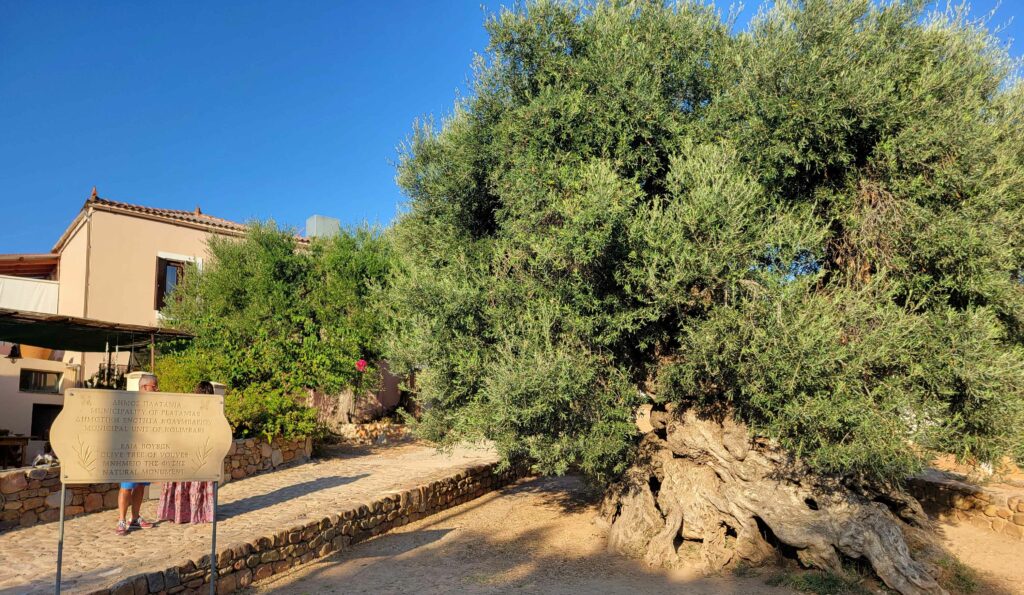
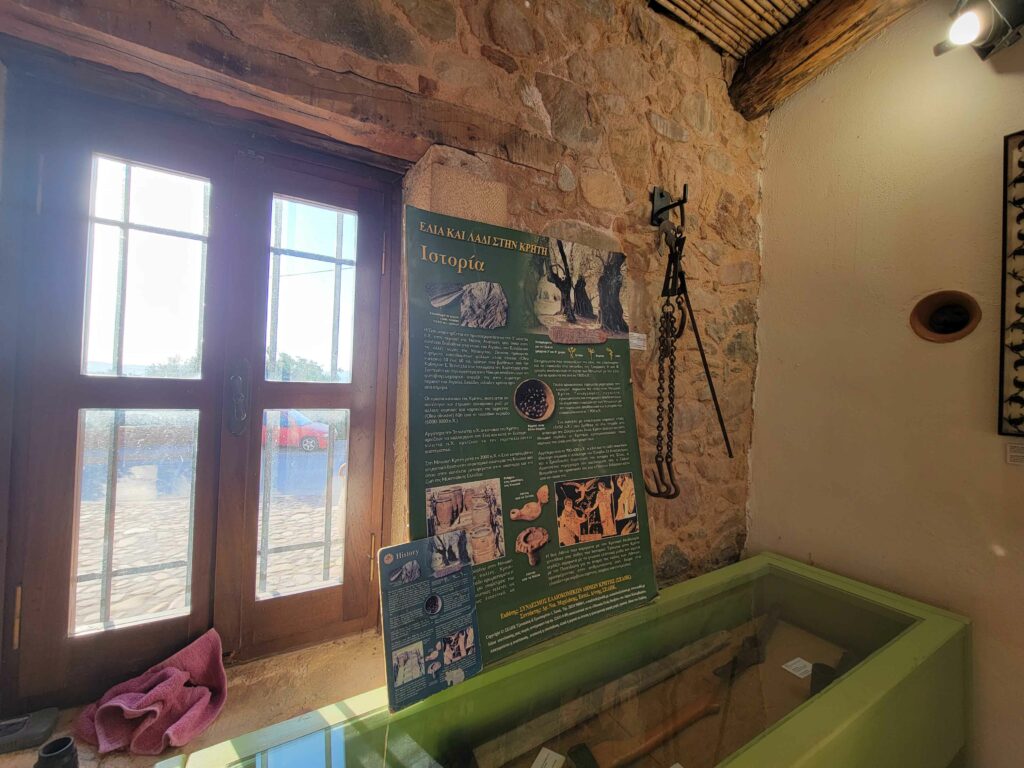
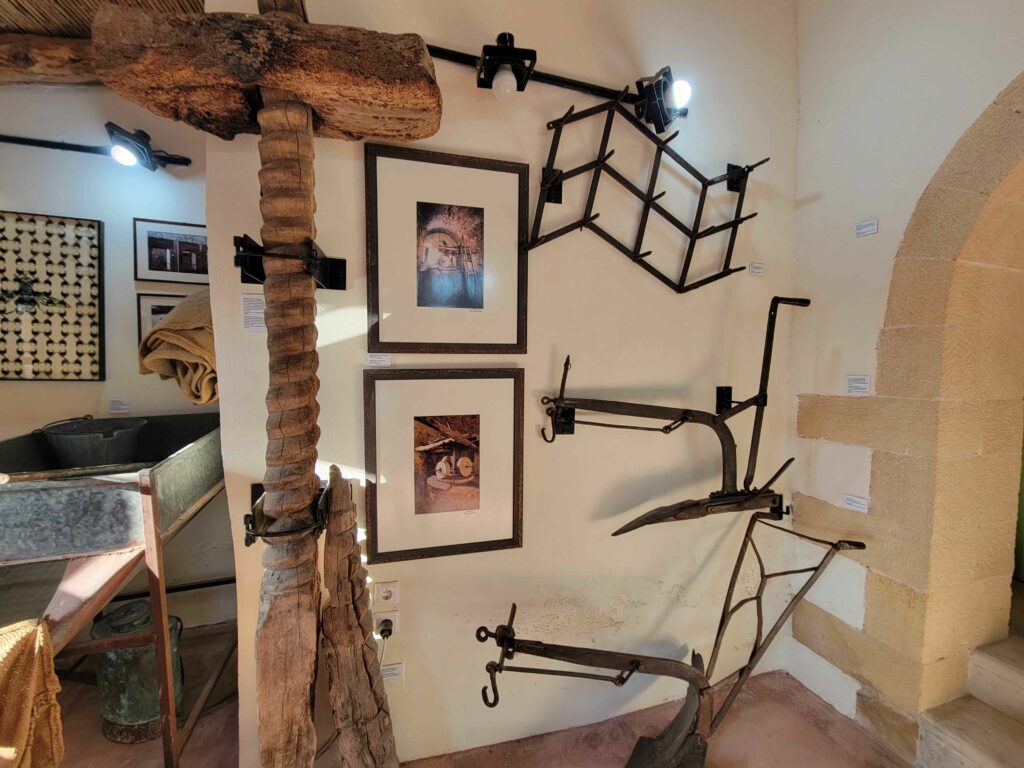
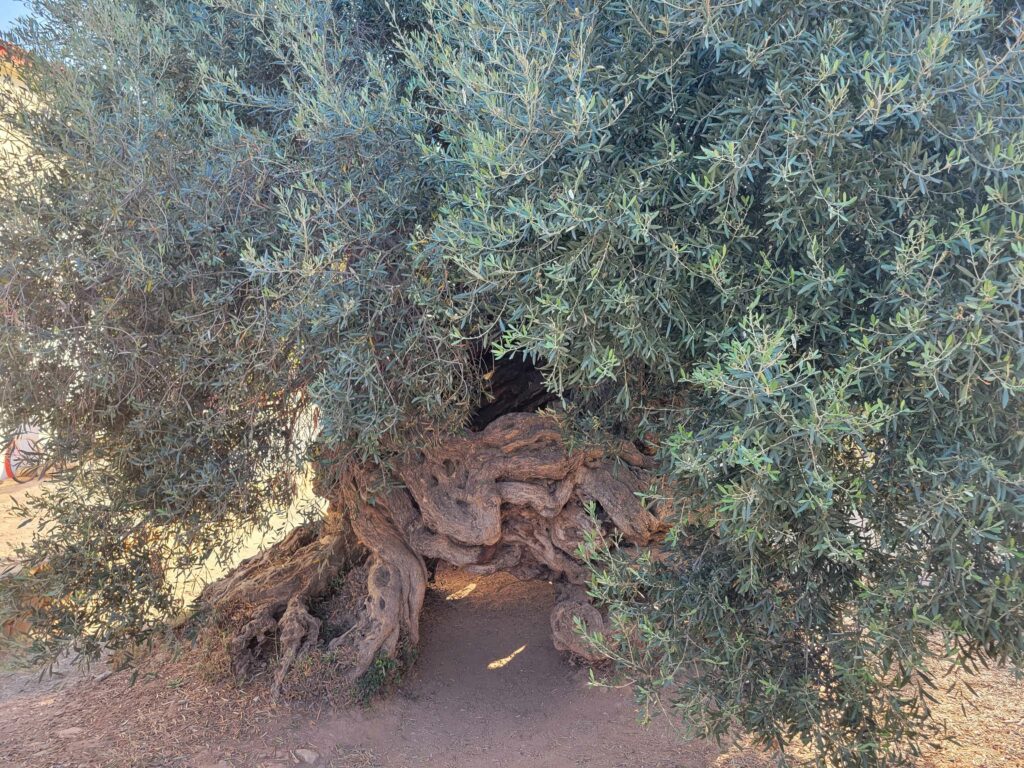
The tiny town of Ano Vouves a little ways west of the city of Chania. The winding roads are surprisingly easy to navigate, and though at times you are required to pass through the villages carefully, it isn’t hard to reach. You see the tree before you even come to a complete stop, unable to miss the gargantuan trunk and mass of branches. Parking is easy, right in front of the tree itself, which is good because once you’ve made it there, it’s difficult to look at anything else. Around the tree, the buildings all cater to the celebration of The Olive, from a tiny museum related to how olive harvesting was carried out, to olive oil-based products, and even a café that sells ice cream and olive oil products, all from those olives harvested by a tree in the center of the square. This is the oldest olive tree in all the world, though the signage indicates we cannot be more precise. We are able to place the tree anywhere between 2,000-4,000 years old, but cannot test for sure due in part to both the age of the tree and the fact that the heartwood, the thick center of the tree, is no longer present. Scientists at the University of Crete are responsible for giving us as close of an age approximation as we have.
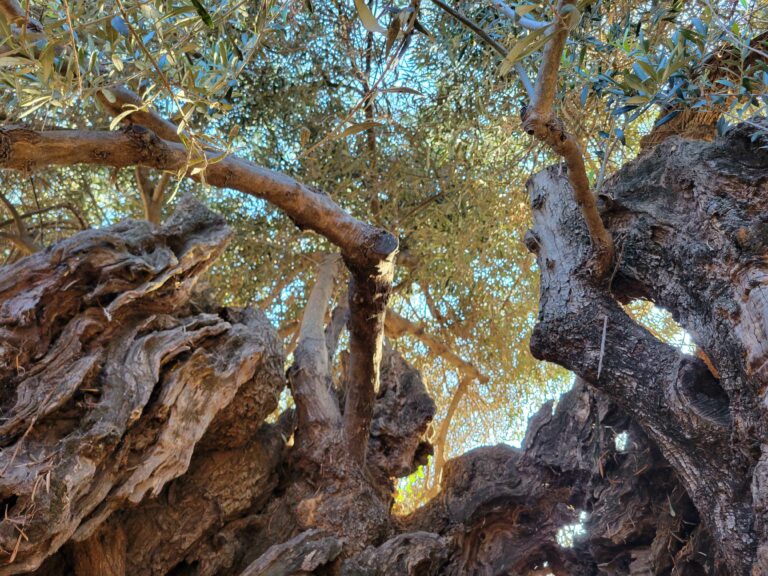
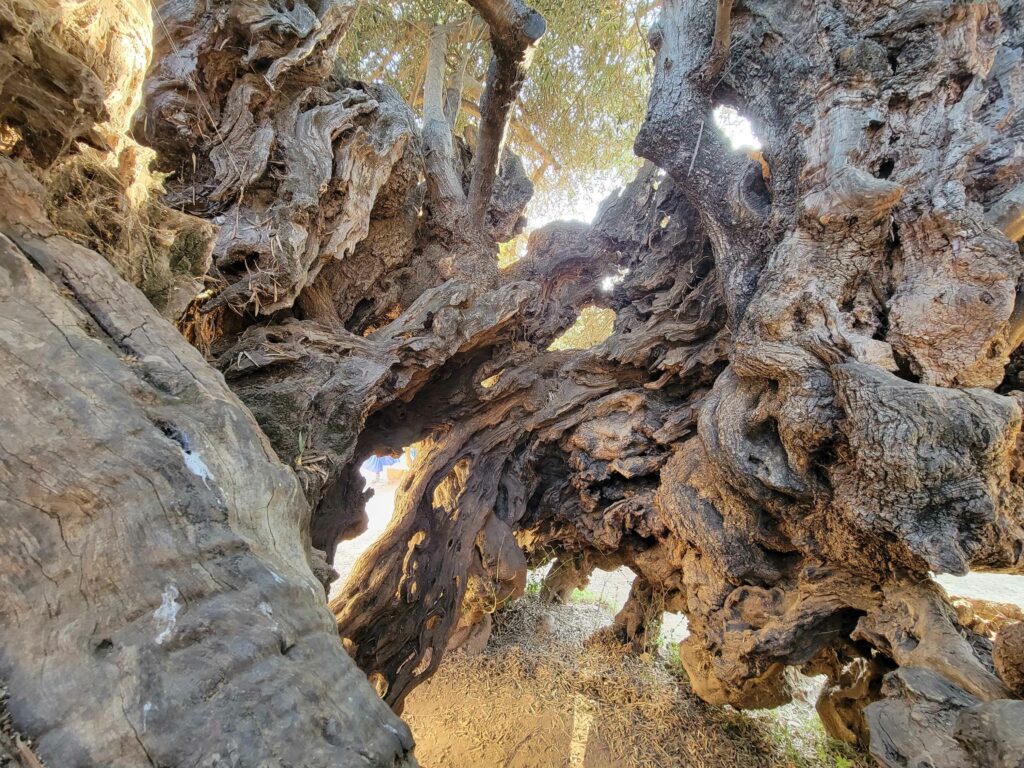
The tree itself is a great, imposing thing, almost akin to a great sleeping god rather than tree. It is within a dirt patch, with bricks creating an ankle-height wall around it. It is thick, its’ knotted wood twisting and knotting in great patterns across its’ trunk stretching into the ground like thick legs. It gives the impression that at any time, this hulking beast of a tree could uproot its’ mighty legs and walk away. It is perhaps the thickest olive tree I’ve ever seen, almost 15 and a half feet in diameter, and yet the only olive tree I’ve seen that is hollow at its’ center. Instead, if you’re so inclined, you can peek through into the center of the tree, stepping into another world of dappled light, bugs, and the sound of a breeze wafting through the leaves. It is almost as if the tree body has become a living temple to nature, complete with a choir of cicadas singing hymns to olives. I touched the tree, and touching a living thing that was old enough to be domesticated by another civilization astounded me. It was like touching something holy, and in many ways I suppose I did touch something holy. What is holier than a tree that fed and nourished not just the Greeks, but the Minoans before them? One of the first wild olive trees to fall tame to the hands of man, outlive them all. Still it lives. Still it breathes. Still it grows its’ roots into the Cretan earth, still it produces olives for the locals of Vouves to take, to grind oil from it, to take care of the tree in return.
When I visited the tree, there were children playing all around the square. I wondered if it must have always been like this, the sun shining down on this great tree as it watched the world around it live, running about just like the ants about its’ branches. I wondered if it could feel my touch, what level of awareness such a thing like that could have. I wondered if it was, perhaps, the oldest living thing, let alone tree, in all of existence. I wondered what all of that meant.
I was not there for longer than perhaps an hour. I stayed for some ice cream and watched the tree from the covered patio as I ate, listening to the cicadas, feeling the breeze on my own skin. I smiled at the sound of a tourist train coming to fetch passengers to other places, possibly to Chania which was only 30 miles away. The sunset was coming, and with it the beloved Golden Hour all photographers chased, and I felt that the tree was more beautiful than anything I’d ever seen in my relatively short life. I would be a blip, if that, in the lifespan of this tree. I would not even be a memory, if trees are capable of such a thing. But the impression that this giant of branches, leaves and wood left upon my mind is set in stone. I felt a peace I’ve only felt in the halls of forgotten churches, in quiet cemeteries, in hallowed ground.
If only God can make a tree, he certainly knocked it out of the park with this one.
The words ‘Greek Literature’ tend to conjure up very specific images: Marble busts of Homer and Herodotus that sit in dusty shelves of a library sandwiching well-read copies of TheIliad and TheOdyssey with bent spines and dog-eared pages. For some, the first thing that comes to mind is a beaten up school copy of Edith Hamilton’s Greek Mythology annotated with notes from a 9th grade English teacher. Still others think only of the great works of the first philosophers; these are the people who tend to store quotes by Aristotle, Socrates, Plato, and Diogenes in their heads that are then pulled out every so often to spice up a paper or impress friends at parties. Have you guessed what all these people have in common? ‘Greek literature,’ for them, begins and ends in Antiquity.
The misconception about where Greek literature begins and ends begins, for many Americans, in school. The countries you focus on shift in the chronological order of who’s empire collapsed first: Greek, Roman, British, American. Once in higher academia, students have the option of finally venturing into the cloudy world of ‘World Literature.’ This is a catchall term for any countries that aren’t America or England, and serves to lightly, (and I do mean lightly), gloss over literature from countries such as India, Kenya, West Africa, France, Columbia, or Japan. These classes, usually coupled into Levels 1 and 2, are meant to pique interest in the literature from these countries, rather than act as comprehensive lenses into their world. Years and years can be devoted to American literature from the 20th Century alone, whereas one elective class groups Gabriel García Márquez with Salman Rushdie and pats itself on the back. Mission accomplished.
Meanwhile, in the average American bookstore, what gets sold is once again a reflection of the almighty cultural timeline: the American and British greats are well-stocked, from Ernest Hemingway to the latest pulp novel. French authors are more often than not relegated to those published between 1600 and 1800, with a brief burst from the 1920s. Russian literature is often not found except for books from the late 19th and 20th centuries. If you happen to be looking for any authors from any South American country, your local big-chain-bookseller will gladly point you in the direction of 100 Years of Solitude, which you have already read at least three times over. And Greek literature? Well, says the big-book-chain, the latest translation of The Odyssey is right here. Or perhaps, if you’re daring, you’d like to try some Aristophanes.
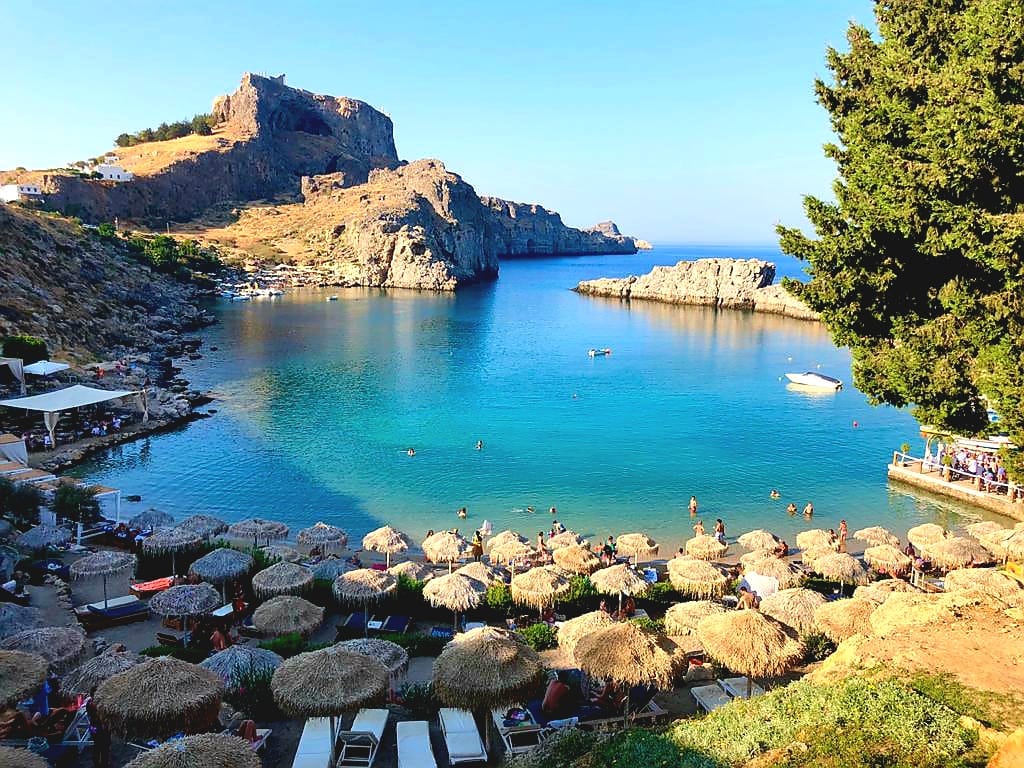
Anthony Quinn Beach, Rhodes
All of this is to say that I was left with the distinct impression that the world left Greece behind in the cultural literary zeitgeist. This is patently untrue, of course, but it is what most Americans are left believing. How insulting it must be to think that the country that created theater would simply stop creating. The Greek people, and the many facets of their regional identities, did not stop the act of creation just because a continent across the ocean stopped taking notice of them. Greek literature has evolved over the centuries into many beautiful forms, still speaking to the human condition with as much truth and potency as they did 2,000 years ago.
This brings me to the Athens airport circa the summer of 2023. Due to several connecting flights I had not slept in over 24 hours, unable to catch more than five minutes of a blissful computer-like shutdown of my brain while curling up on a bench by my gate. When it became too much for my aching, nearly 30 year old back, I made the executive decision to surrender my seat in favor of window-shopping. On my side of the airport, most of the shops were decidedly out of my price range, luxury brands that were nice to look at but not to touch. What was left to me was a nail salon, food, and the airport bookstore, and as I had another two hours before I was supposed to board my flight to Crete, I figured a little once-over couldn’t hurt. In that moment I both celebrated the mass variety before me and cursed my inability to read Greek. There were swaths of books from every era, especially the postmodern movement, from Greek writers I had never heard of. Poetry books, folklore, dramas, and more were suddenly open and available to me, and I felt myself overwhelmed by the possibility of entering a new world of literature I had never entered. Still, I carefully picked out ones that stood out to me immediately, carefully laying them out in my carry-on bag so I could begin my reading on the plane. In that instant I fell down a rabbit hole, beginning a journey I’d like to share with you now as I take you on a sort of beginner’s course of the importance of Greek literature.
I first learned about the existence of The Erotokritos while sitting on a tour bus in Heraklion, days after my experience in the airport bookstore. Growing up I had a great fondness for ‘The Classics,’ and in my youthful ignorance I assumed I knew all of the important ones, as well as which were ‘worth my time.’ Reading Renaissance literature was a delight for me in college, and though I was in time able to combat most of the erroneous beliefs from my youth, I was still under the assumption that I had a pretty good knowledge of even the more obscure texts. So imagine my surprise when I learned that Crete had contributed the best example of Renaissance poetry that you’ve never heard of.
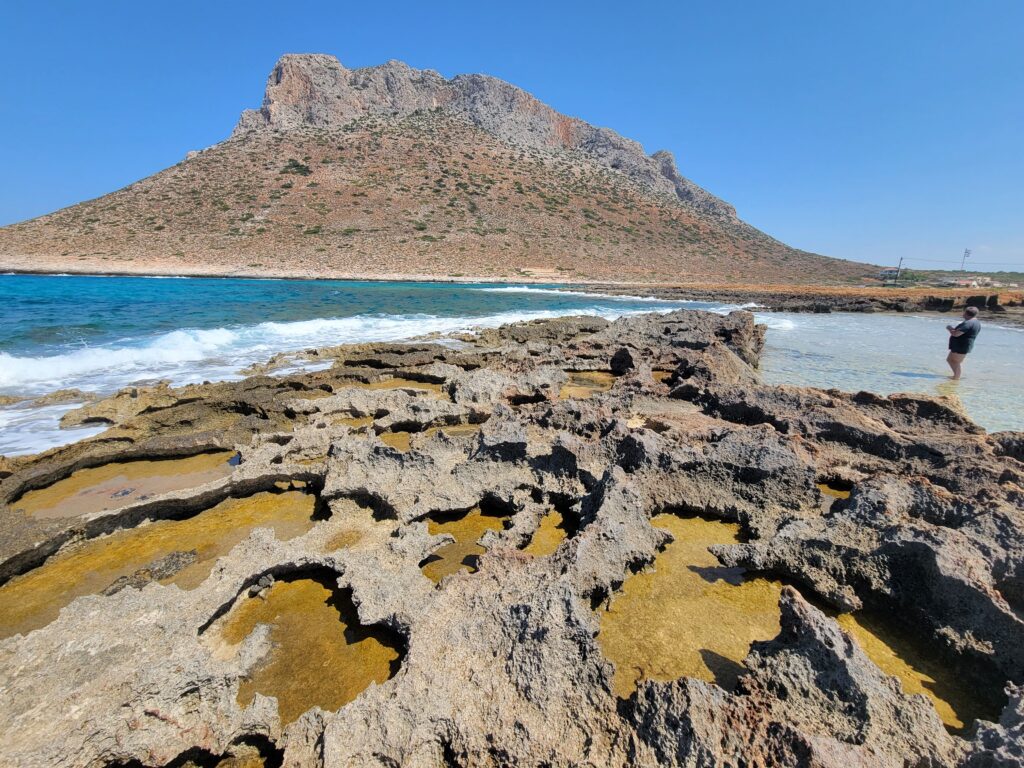
Stavros Beach, Crete
Written by the Cretan-Venetian noble Vinsentzos Kornaros between the years 1590 and 1610, The Erotokritos tells the story of the love the titular Erotokritos has for the Athenian princess Aretousa. Like the more widely recognized Cyrano de Bergerac, Erotokritos woos the princess by singing beneath her window in the dead of night so he may preserve his identity, and she, of course, falls for him. The king of Athens disapproves of a mysterious stranger wooing his daughter by night, having no knowledge that the man in question is a favored member of his own court. Like many grand love stories of the era, our couple is separated by a murder plot, a time skip, mortal peril, and concludes with our hero testing Aretousa’s love for him with a well-placed disguise and a sincere yet dramatic declaration of love. And to top it all off, this epic poem has a happy ending. Though modeled after the French poem Paris et Vienne, the uniqueness of The Erotokritos cannot be denied by readers. It takes on not just a decidedly Greek interpretation on the value of true love and courage, but is also unmistakably Cretan. The dialect in which the poem is written comes from that island, and even more specifically, from Sitia. If I were a proper linguist, I would delve into the magic that is Eastern Cretan idiom, and how the author’s own Cretan-Venetian heritage influenced which words he used that were derived from Italy’s influence on Crete. This poem went on to inspire the poet Dionysios Solomos, the poet whose work Hymn to Liberty became the Greek and Cypriot national anthem. It inspired countless other poets and Cretan musicians, and was first translated into English by doctor and naturalist Theodore Stephanides, the mentor of Gerald Durrell. This is, by any right, a text that anyone could classify as ‘Important’ with a capital ‘I,’ and yet I’d never heard of it until I decided to take a bus tour on a sweltering summer afternoon.
This period of time is an interesting time for literature. During the same 20 year period it is estimated that The Erotokritos was written, Christopher Marlowe published both parts of Tamburlaine, followed by his adaptation of Doctor Faustus two years later. Edmund Spenser published books 1-3 of The Fairy Queen. Shakespeare’s Hamlet premiered to critical acclaim. Miguel de Cervantes published both parts of his epic Don Quixote, with a ten year gap in between each part. This small slice of the Renaissance produced immortal works that now permanently live on the periphery of our cultural knowledge. Even if you’ve never read these stories, you know enough about them to understand their importance, you know enough about them to understand the in-jokes. Why, then, is this seminal work of Greek (and, especially, Cretan) literature left out of the commonly taught canon of Renaissance literature? Why keep alive the Greek myths and stories from antiquity, but not this? Is it somehow less accessible or relatable than Don Quixote? Is it less emotional than Hamlet? Perhaps if a Disney executive or a Broadway producer had read it and slapped some show tunes onto it, more of the West would widely recognize this work. But it’s for the best, I think, that The Erotokritos remains a hidden gem waiting to be discovered by new readers, preserving its own deeply entrenched musical tradition as it continues to inspire poets, writers and musicians alike just the way it is.
Nikos Kazantzakis is perhaps the only name I’m going to reference that you might recognize. His two most famous novels, Zorba the Greek and The Last Temptation of Christ, have been adapted into critically acclaimed films that most American audiences would have a tertiary knowledge of. The film starred Anthony Quinn as the titular Zorba, and his interpretation left such a lasting impression that there is now a beautiful beach in Rhodes that bears his name. Cinephiles, at the very least, would probably recognize iconic dance scene in Zorba where, at the very end of the film, the titular Zorba teaches Greco-British Basil to dance in a final expression of mad exuberance. Out of context, this scene has been referenced and parodied to death, but within the film the dance expresses a bittersweet testament to the fickleness of life. I’ve been to the beach where they filmed portions of this movie. I swam in the water and looked up at the cliffside, I ate at a taverna just down the street from where Anthony Quinn stayed during the shoot. And yet, before this trip, I had not read a single thing by Kazantzakis. The novel is just as powerful, if not more so, as Kazantzakis’ prose elevates the story to a higher level. I found myself charmed and infuriated by the boisterous Alexis Zorba as much as Basil was, and the ending of the book was more emotionally potent than the movie had been, leaving me with an almost empty feeling I sat with for quite a while.
The Last Temptation of Christ was one of many of Nikos Kazantzakis’ explorations into faith, who Christ was, and what it all meant to be ‘Christ-like.’ The story goes into what it means to actively choose to assume the role of Messiah, what a normal life for Jesus could have been, and what surrendering to God’s will and ultimately rejecting the ‘last temptation’ meant. It is considered to be the most controversial work Kazantzakis wrote, as well as his most deeply spiritual, and for it he was excommunicated from the Orthodox faith. Audiences today still seem to miss the point of the work, with every facet of Christianity protesting not only the book itself but the film adaptation directed by Martin Scorsese. Like Kazantzakis before him, Scorsese was met with death threats, and the film is still banned in certain countries around the world.
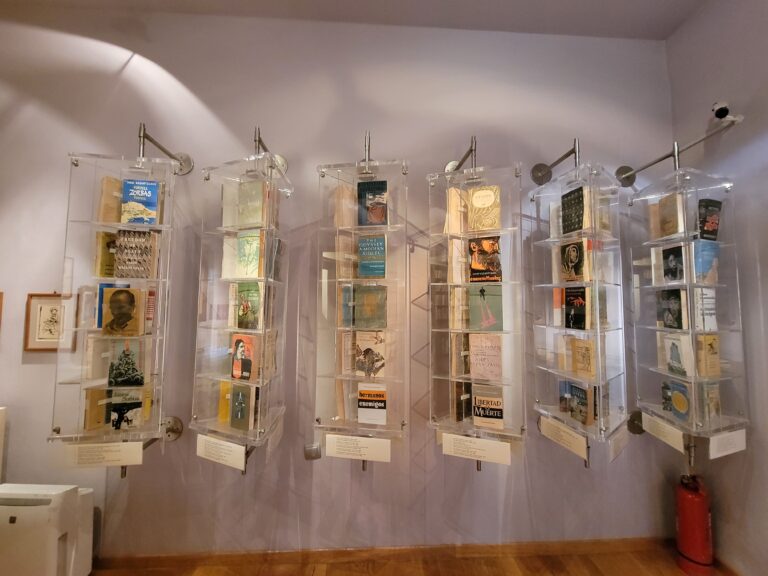
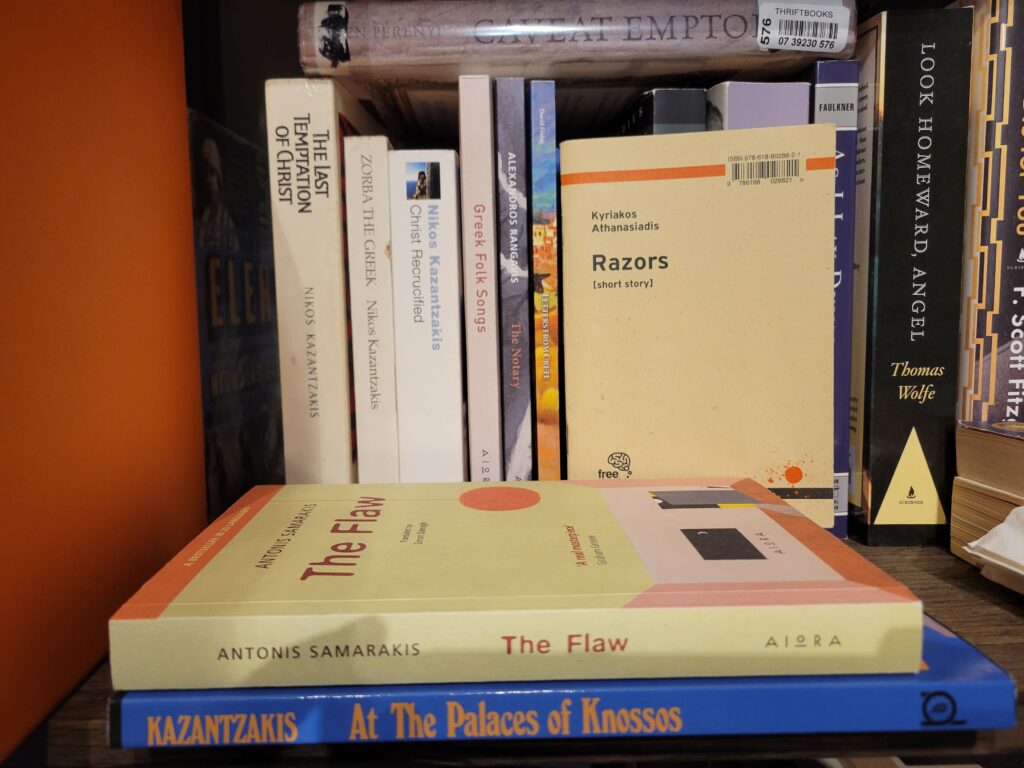
Kazantzakis wrote 6 travel books, 15 novels, 8 plays, 2 poems, and 14 essay collections and memoirs. I have named 2 books. Two, out of his entire bibliography. I had no idea, before traveling to Greece, they even existed. I knew of Zorba and Last Temptation from an early age, and the copies of the books I own were easy enough to find. But I recognize that I am not the standard: many of my friends didn’t even know Zorba was a film, let alone a book. They assumed it was simply the name of a song. Kazantzakis’ work has been very important to me, and when I found the rest of his bibliography in a small bookstore in the port of Chania, it took everything I had not to walk out with every single thing he had ever written, at least those translated into English. Christ Recrucified, the story of a small town attempting to put on their annual Passion Play, is a powerful story about what a religious ritual means to a place under occupation. At the Palace of Knossos is a retelling of the myth of the Minotaur, but it examines it as metaphor for failing empires and colonialization. After all, the island of Crete was once its own mighty empire that, after natural disasters and apocalyptic events, became Greek. I have yet to work my way through all of the books I purchased, but each one connects with me in new and unexpected ways. There is something profound about his prose and the questions he dares to ask that are so quintessentially Greek, so quintessentially Cretan, that I cannot help but feel an attachment to him.
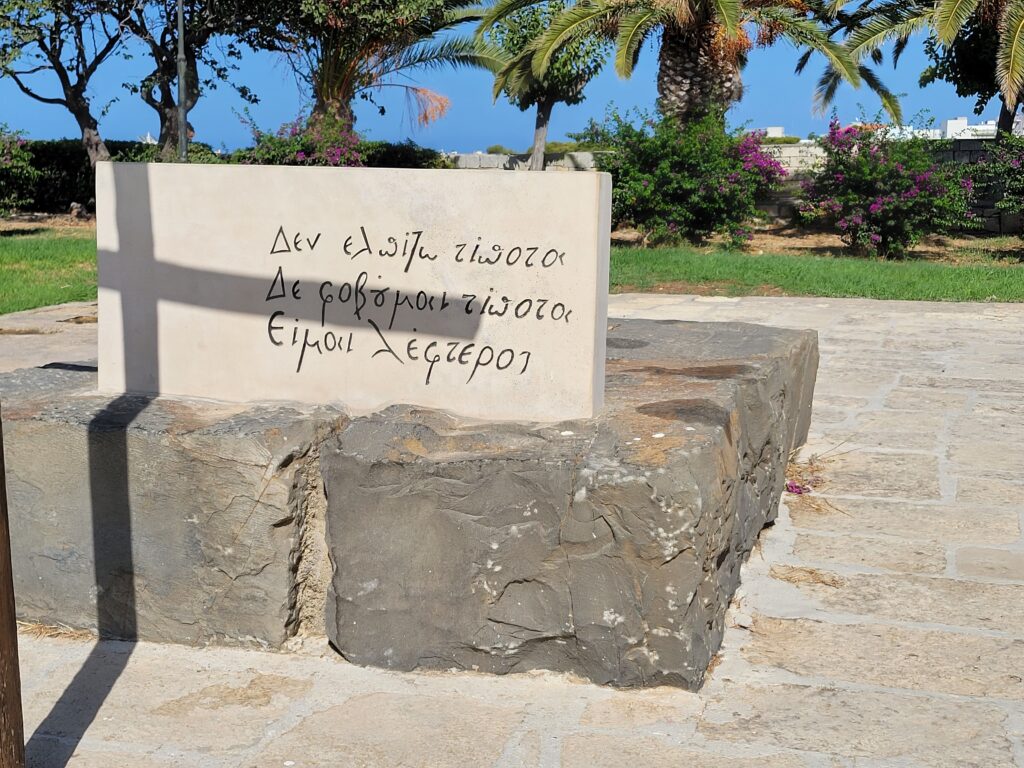
I visited his grave at the top of a hill that overlooks the city of Heraklion. I had never been before, in all the visits I had paid to the island, but something about this trip made me feel that it was finally time. It isn’t in a place you’d expect there to be a grave, and the walk up the hill is at time a little strange as you pass through well-paved but heavily graffitied stairs. The site is not hallowed ground, but as I stood in the quiet, staring at the large stone slab marking the place where he was buried, I could not help but feel that the place had a kind of serenity to it. Nikos Kazantzakis’ gravestone reads “Δεν ελπίζω τίποτα. Δε φοβούμαι τίποτα. Είμαι λέφτερος.” Translated, it means “I hope for nothing. I fear nothing. I am free.” Though scholars have stated (and I am sure they’re right), that Kazantzakis meant his epitaph to be a larger reflection of his cynicism, I could not help but view it in an almost Buddhist lens: I have no expectation, and so I am free of it. I am at peace. I stood on the top of that hill, silently watching as the wind blew through the trees, coming as close to meditation as I ever have, and as close to a communion as I could have in several years. I don’t know if he would have approved of me treating his resting place as something sacred, but I couldn’t help but feel as if, despite the lack of a blessed resting place, there were clear traces of a kind of divinity.
I came across Antonis Samarakis’ The Flaw in that airport bookstore, hooked by the title that both intrigued me and made me wonder, ‘the flaw in what?’ The answer to that question is a sucker-punch to the gut, and one that made me seriously consider what it means to live freely. Set during a time of an unnamed fascist regime, The Flaw follows three characters set on a collision course that results in an over-the-top plan to cause one of them to confess to belonging to the opposition. We never learn what ideals the regime holds up. We never learn what exactly the opposition is working for, except of course to be in opposition to the regime. What see are glimpses into the humanity of the characters as they desperately try (and ultimately fail) to remain nothing but cogs in their respective machines. The Flaw is not an easy read: from jumping timelines to constantly shifting viewpoints, it is a book that one must pay their full attention to. The payoff, however, was one of the most satisfying things I’ve read in years, and left me with the bittersweet revelation that all totalitarian regimes like this are doomed to fail, so long as humanity endures. It was a powerful piece of literature that was a haunting prediction of the real-life Metaxas regime that took over Greece in 1936. Perhaps Samarakis saw the writing on the wall where he saw his country headed. Perhaps it was a general warning to the world to be wary of the rise of totalitarianism. Either way, the novel serves as a timeless testament to the power of a human bond, and how as long as we are able to recognize each other’s inherent humanity, there will always be a flaw in the regime.
After I finished reading this book, I turned it over to give the cover another glance. The edition I grabbed was the fiftieth anniversary edition, its minimalist design of the cover adorned with a snippet of praise by author Graham Greene. ‘Graham Greene?’ I thought. ‘Leading voice of the 20th Century Graham Greene? Author of Brighton Rock, The Power and the Glory, and The Third Man Graham Greene?’ I opened the front cover to find further glowing reviews from other authors I knew: Arthur Miller of The Crucible fame. Agatha Christie, Queen of the Detective Novel. I looked briefly at my new copy of Kazantzakis’ Christ Recrucified to see praise from Thomas Mann, author of the well-known Death in Venice. All these authors I grew up studying, respecting, admiring even, were paying their respects to Greek authors who I either knew the bare minimum or nothing. Where was the justice in that? Why were these stories widely circulated enough in these authors’ times, but not mine? I still don’t have an answer that satisfies me. Yes, at the end of the day, books are a commodity: books that make money continue to be printed. Books that do not are retired to the dusty shelves of a used bookstore that may or may not carry what you seek. I understand this is the way of things. But perhaps, if this mindset of what we value in literature could change, then maybe these important novels have a chance of staying relevant longer than the latest fantasy romance novel that has TikTok in a chokehold.
If you’ve stuck with me up to now, you may be asking yourself: what on earth does this have to do with travel? That’s a fair question, and most people who read this blog would generally prefer I’d stick to talking about beaches and historical points of interest, (which, in my defense, I mentioned one or two). But think about this: every time you’ve gone somewhere new, you’ve researched the language. ‘Where is the bathroom?’ ‘Can I get the check?’ ‘Where is the library?’ You do it as a courtesy to the people whose land you are visiting. You do it to serve as an outstretched hand, to show you are willing to go a step further to bond with a fellow human being, to prove that we have more in common than we have differences. Literature, especially literature created by and for the people of a place you plan to visit, adds a very important layer to travel. It adds an insight into the cultural mindset of a place, what art they find important enough to treasure and what values they uphold. Art is not and should not only serve as inspiration to travel. Art is why we travel.
So the next time you click ‘book’ on your travel website, take a moment to look up the writers, the poets, and the playwrights. Pick a short story or a poem. Read it carefully until it digests into your bloodstream, until you can hear the soul of the place calling out to you from within yourself. Take it with you when you go.
I spent most of my childhood in the little-known, secluded seaside town of Miami, Florida, and as such I am no stranger to aquariums. An appreciation of marine science was ingrained in me at a young age, and though it never went farther than that, (note how my career has focused almost exclusively on the written word), visiting aquariums remained a favorite pastime. I tend to seek out aquariums every time I travel to a new place, and usually spend at least one happy afternoon whiling away the hours with the sea creatures on display before I continue on with the more traditional vacation spots.
But this time, I was in Crete, Greece. Crete! Land steeped in history, mythology, culture, and scenic backdrops to make your Instagram followers quake with FOMO envy. I had more than enough to occupy my time, between the gorgeous ruins and crystal clear ocean waters. I was busy with museums, new towns, pink-sand beaches, and mountain hikes. Did I really need to seek out another local aquarium?
Of course I did. How could I not want to see it, after seeing signs plastered all over town? Since I was traveling with my sister, I posed the question to her: did she want to see the CretAquarium? She immediately assented, especially after she found out it was located right next to a dinosaur theme park. But I’m getting ahead of myself.
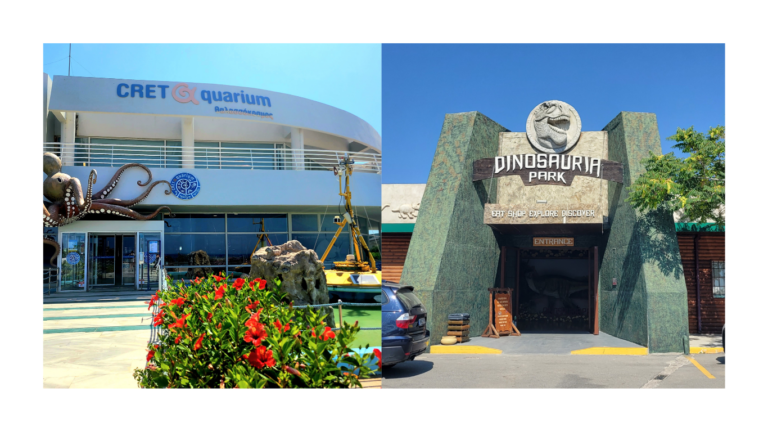
The CretAquarium is located in the town of Gournes, just 15km outside of Heraklion. From where my sister and I were staying in Wine Dark Sea Villas’ Villa Bella Mare, it was about a 20 minute drive down the leisurely A90 highway until the Old National Road, and from there it was a simple matter of trusting the maps app implicitly. The CretAquarium is located in what is best described as an ‘educational compound,’ where two other science-based attractions, a planetarium and the aforementioned dinosaur park, greet you before your final destination. I followed the signs along the winding road to the aquarium and found, to my surprise, a lovely beach. While I suppose the possibility of a beach should have been something I was prepared to take advantage of, considering Crete is in fact an island, the idea of making my trip an aquarium/beach day combination had not crossed my mind. My advice is, on your next trip to Crete, always keep a bikini in your back pocket in case of emergencies like this.
The CretAquarium is a large, rounded building, adorned with a picturesque mosaic of an undersea scene. In a shallow fountain, a model submarine used for undersea exploration sits as you make your way to the entrance. A giant, plaster octopus that sits above the door, beckoning in visitors who have since found themselves distracted by the numerous and overly affectionate stray cats that wait for visitors to share their café snacks. Still, the promise of air-conditioned relief is often enough to pull people away, and was in fact just what I and my sister needed to prompt us to enter the building before another cat begged for our attention.
My ears were instantly bombarded by the sounds of excitable children who were eager to move through the line and into the tunnel leading to where all the fish lay, which was perfectly understandable. But I chuckled at the sheer number of couples, all either in their late teens or early twenties, who were eager to use the low lighting and shimmering lights as the way to set the mood for a romantic interlude. My sister and I, for our part, wasted no time in indulging in the whimsy of it, posing for pictures in the low blue lighting of the entrance. Speaking of color, the CretAquarium is actually the first aquarium in the world, not just the country, to be accessible for the colorblind. Upon entering the museum, should you need it, there are QR codes posted for a free app called ColorADD that the aquarium has made an effort to integrate into their exhibits.
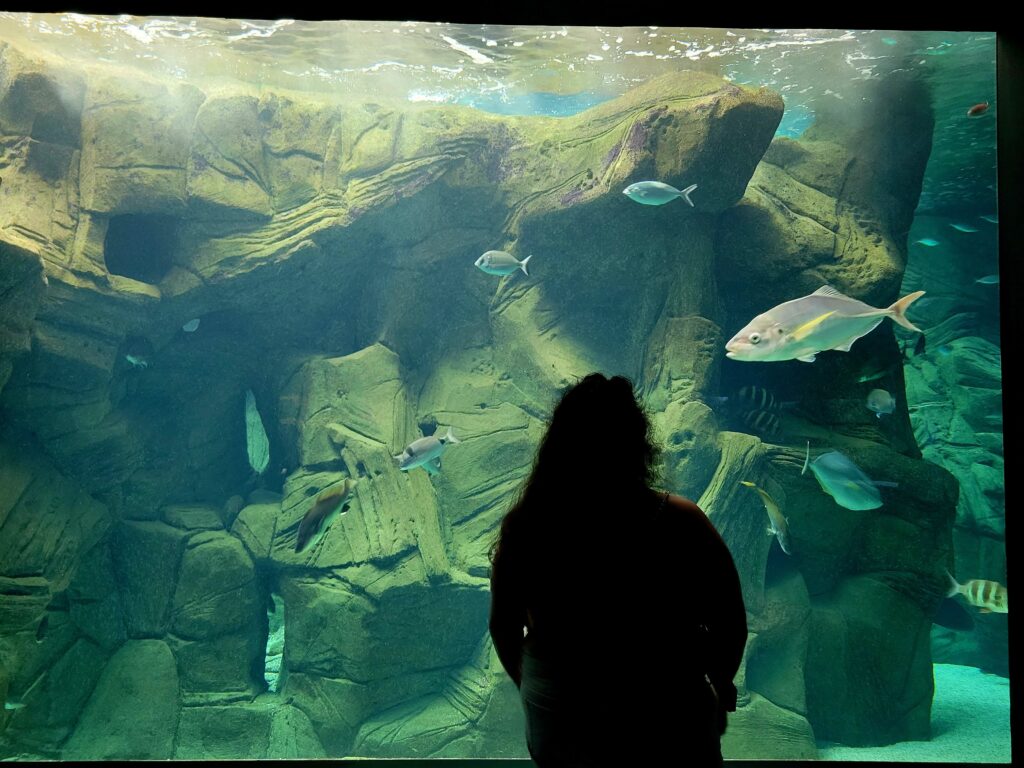
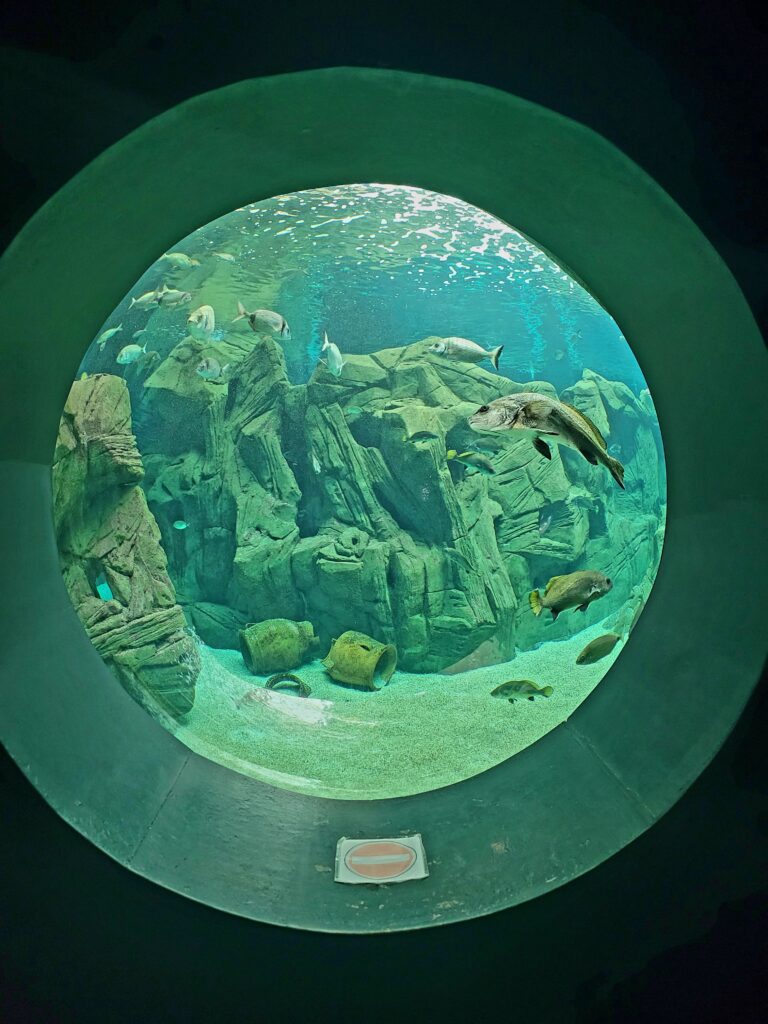
Inside the aquarium proper I was initially taken aback at the dulcet tones of Enya playing softly over the speakers. I had never considered how aptly her music is suited for watching large, colorful fish drift beyond a pane of glass as artificial light filters through the waves. It was an interesting and, dare I say, oddly beautiful experience. I felt that this might be the closest I could come to experiencing what a day in the life of an undersea creature must feel like, minus the constant struggle for survival. I’m sure the music was accurate to what they would experience. It was incredibly appropriate, and my sister remarked as such. The informational plaques, written in both Greek and English, were incredibly informative. I had no idea of the richness of biodiversity in Greece’s waters. I knew that there was a variety of fish, to be sure. Cretan seafood is one of my favorite things about the island. But learning that Crete’s waters were also home to such a variety of life was a wonderful truth to discover.
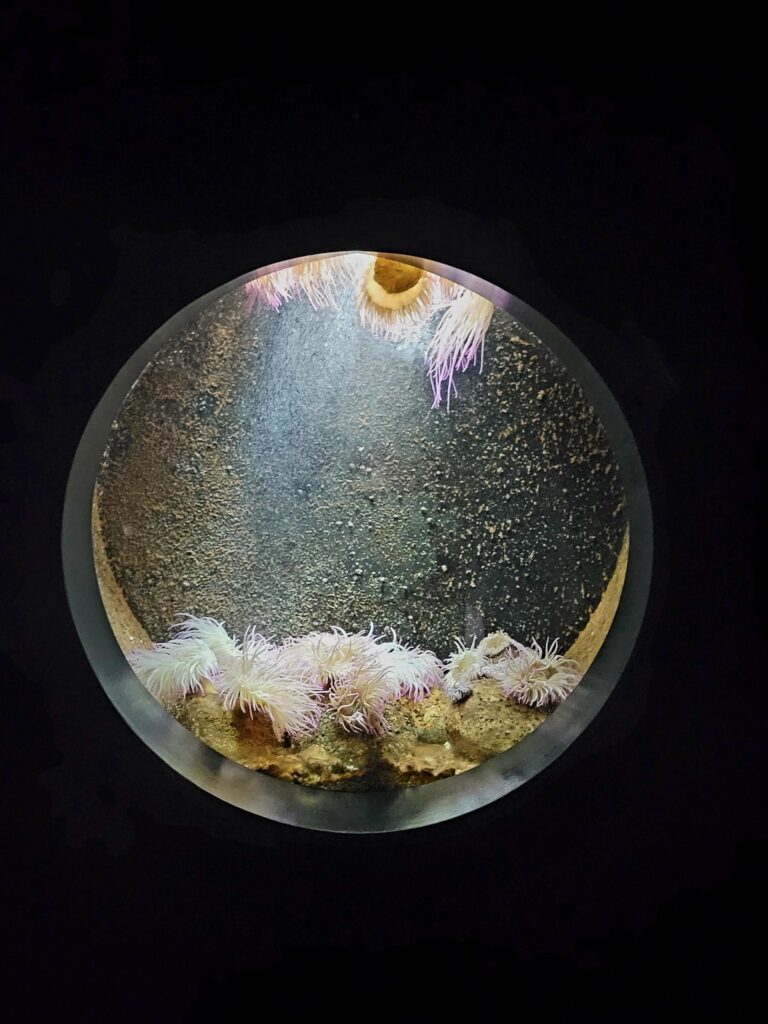
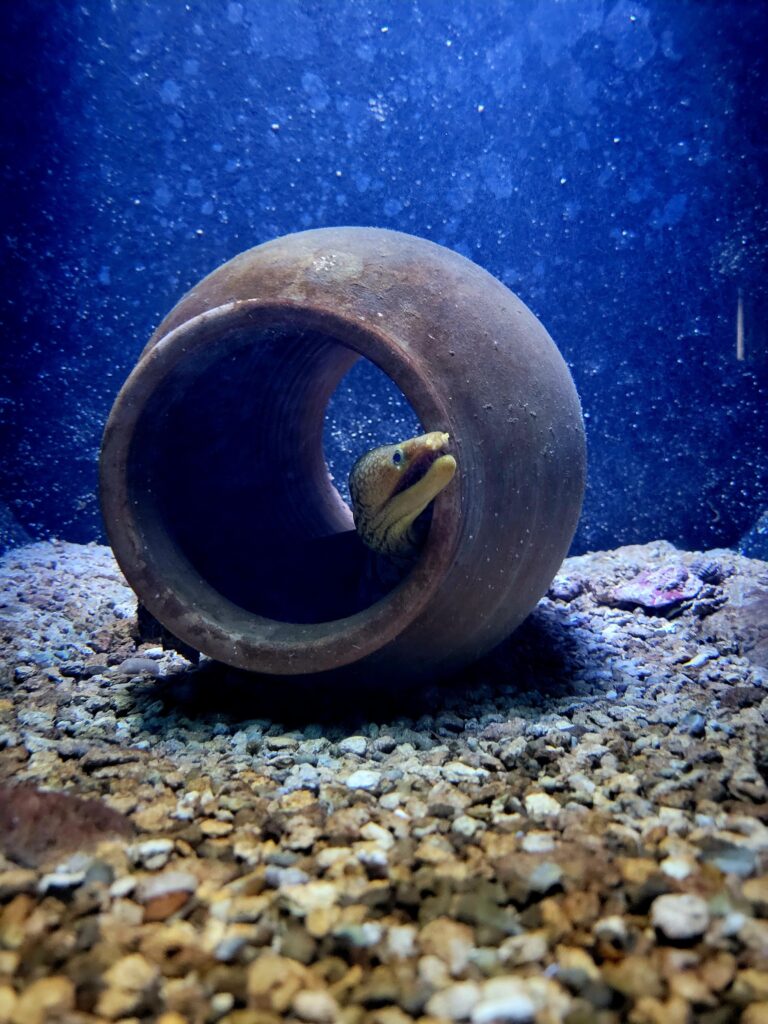
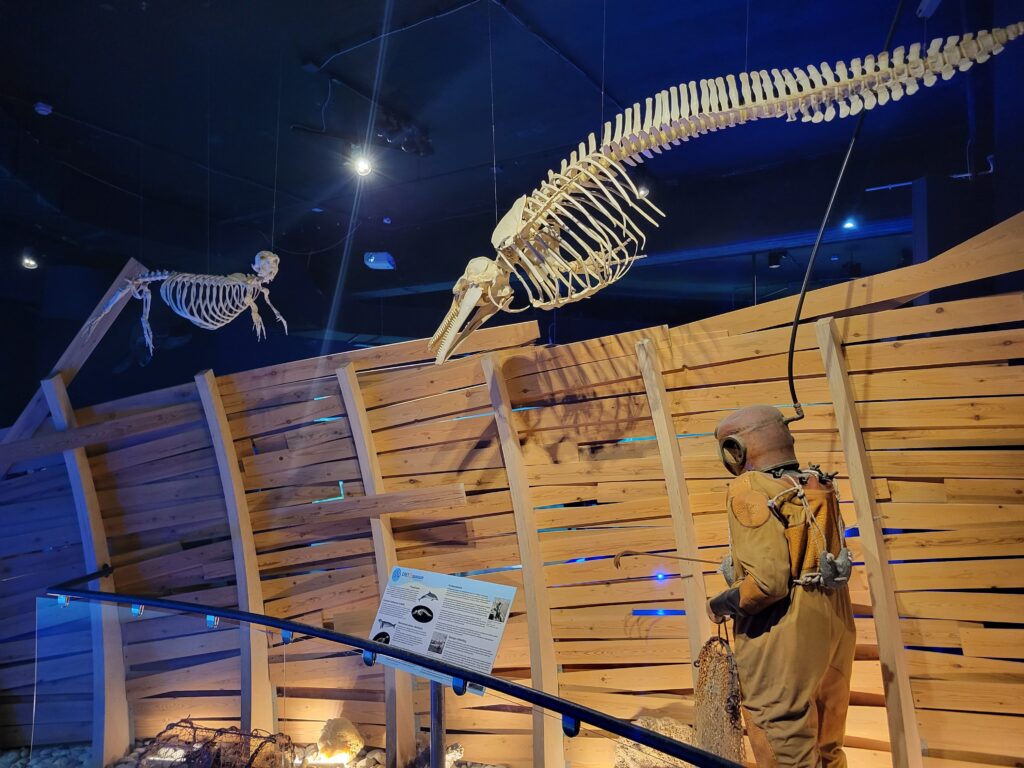
In between the ethereally lit fish tanks, their bluish silver water casting ripples of light on visitors and the surrounding alike, hung suspended skeletons of sea creatures from another age. Whether they were casts or originals, I could not say, but I stared in wonder at what was supposed to be the skeletons of ancient turtles and bottle-nosed dolphins. I admired the great rock faces of what could have been incredible undersea reefs, ruined temples sunk beneath the waves, and a shipwrecked wooden ship that housed a dummy dressed in an old diver’s suit hunting for sponges. The sculptors of the interior structures in this aquarium truly outdid themselves, as the fish had temple ruins, pots, and grand rock faces to swim around.
Besides its incredibly calming atmosphere powered in no uncertain terms the melodies of Enya, was that it inspired a desire to swim, to immerse myself in the very seas I had just glimpsed into. I kicked myself as we left the building, and my sister stared wistfully at the waves as the summer heat descended upon us once again. The sounds of children playing in the waves carried over to us as we walked to the car, and my sister groaned as the wave of heat hit us in the face as the hot air from my grandfather’s ancient Honda roared to life.
It was then that she recommended we try to visit one of the other places in the educational compound, since we had nothing else planned for the day. I shrugged and checked google for the hours. We had exactly one hour and forty-five minutes left to explore the place, so I nodded and made our way up the meandering road back to Dinosauria.
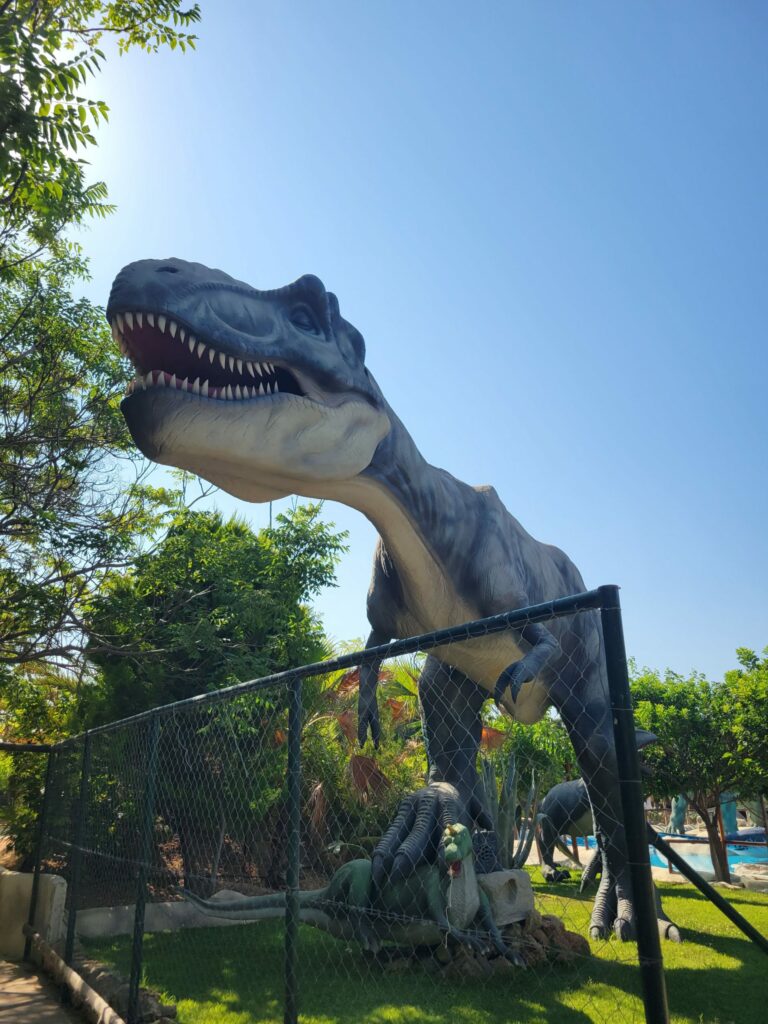
As I pulled up to the entrance, I had to laugh at the homage to the gates of Jurassic Park. The large Tyrannosaurus Rex head sat frozen in a triumphant roar over the entrance, and as we made our way inside the building we decided to refrain from paying for the extra experiences like the interactive science exhibits, seeing as we only had a short time to explore before we closed the place.
We passed under the legs of a large t-rex and into a dimly lit room with casts of enormous fossils. The bronze head of a triceratops was almost gold against the burgundy carpeted room, and the large stegosaurus skeleton cast a mighty shadow on the wall. To leave the room, we had to pass through a rotating tunnel of stars and comets, disorienting us as we traveled ‘back in time’ to the room portraying the annihilation of the dinosaurs. The room was a stage of chaos as the great comet plummeted to earth, destruction and chaos everywhere we looked. The children we passed along the way ‘oohed’ and ‘aahed’ at the tumultuous scene, concerned for creatures frozen in their swan song. My sister ducked under a wicker nest, giving a small start as she noticed the ‘dying’ plesiosaurus hidden among the reeds, but we cut our horsing around short as we heard the excitable sounds of what promised to be more children coming through the tunnel. In our most dignified manner, we followed the path to another tunnel leading to the outdoor area, and stood face to face with ‘life-sized’ animatronics.
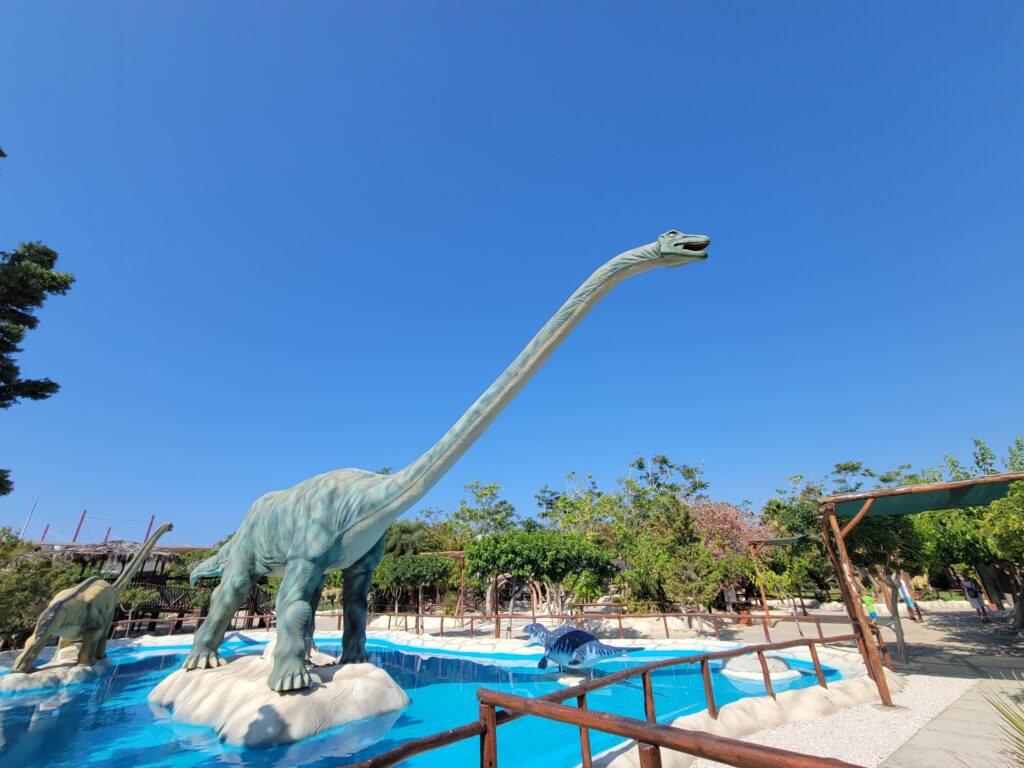
Giant moving figures of rubber, metal and paint roared to life as we stepped onto hidden triggers in the pavement. We were greeted by sounds of the Triassic, Jurassic and Cretaceous periods all at once, as if a mad Greek John Hammond had sprung up and made these creatures real again. Well, perhaps not too real. I’ve seen animatronics of more fluidity, or paleontologically accurate paint jobs. However, the size and scope of these creatures was massive. Wandering the paths took us past an enormous Tyrannosaurus Rex that swung down its mighty head as we slowly walked around it. I marveled at the giant apatosaurus, the feisty liopleurodon frozen in the man-made lake, and of course at the fun sculpted rocks and waterfalls that lined the pathway. Though the heat was unforgiving, I had to admit that being out in the sun was more bearable when surrounded by giant, moving, and sometimes roaring dinosaurs.
Perhaps you think I’m teasing when I say this, but I had the time of my life here. I enjoyed the whimsy of it, not to mention how genuinely well researched and educational this experience was. Though I could not understand the children asking questions of their parents or their parents’ explanations, I heard how in awe they were of the giant beasts. And I have to admit, I was impressed by the scale of the attraction, and how well maintained their dinosaurs were. It was certainly a place I would go to again, especially if I had rambunctious children who wanted a break from all the culture that the adults were more likely to enjoy.
After a brief respite from the heat at the outdoor (but covered) café, where we shared a giant liter of water, my sister and I spent a few minutes contemplating buying enormous dinosaur plushies in the gift shop before ultimately deciding it was time to leave. Though the evening ahead of us was spent at our villa’s pool, relaxing as the heat finally subsided, we left the place with a sense that our day had been well spent. Perhaps the next day we would visit another archaeological site, or a highbrow museum. But today we had indulged in whimsy, and I believe every vacation needs just a touch of that along the way.
Considering the vast number of their species, I never spared much thought for the humble snail.
I’ve eaten plenty of escargot in my life without giving them a second thought. I have indulged myself on Cretan snails on several occasions, enjoying each savory bite. Still, for all my chomping and chewing, I did not spare much thought for the origins of the tiny creature mashed between my teeth. It’s not that I harbored any ill-will for them. I simply was not in the habit of thinking about snails at all.
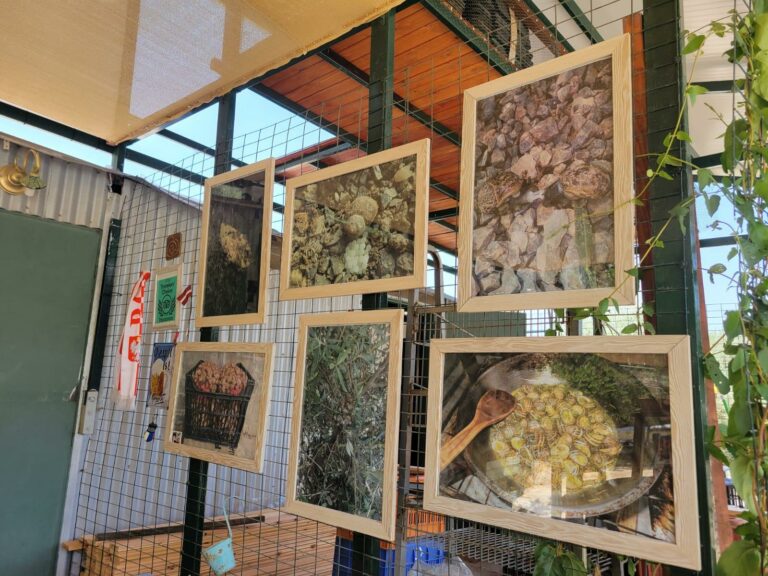
That was to change in the summer of 2023. My sister and I were exploring the small beach town of Ammoudara, on the outskirts of Heraklion, when we first noticed the signs. They were delightful, hand-painted signs advertising Snail Farm and Fun, in the region of Tylissos. I had heard of the concept of a snail farm before, during a television special on a French snail farm, but had not thought about the concept in years. I didn’t realize that Greece, Crete especially, would finally give me the chance to investigate this curiosity. I made plans with my sister to visit the farm the very next day.
From Villa Bella Mare, where my sister and I were staying, it was a leisurely twenty minute drive up into the mountains into Tylissos. While the drive to Snail Farm and Fun was on paved roads for 98% of the drive, the final stretch was a very brief, well-maintained farm road that my grandfather’s 30-year old Honda was thankfully able to manage without issue. It was well marked with more of the signs, reassuring us that we were indeed headed in the right direction.
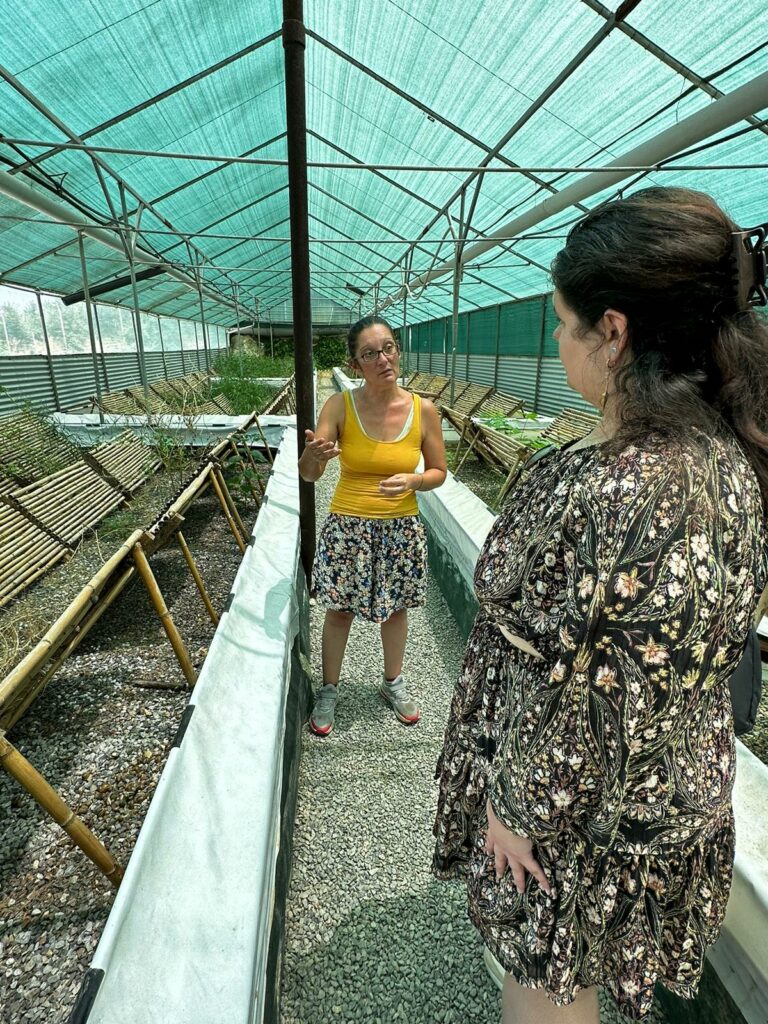
We met Vaso and her husband Stavros, the dynamic duo who own and operate the farm, as we pulled in. Vaso directed us where to park, and greeted us warmly. My sister and I glanced around the peaceful little farm, quiet except for the constant buzzing of the cicadas, and realized that we were the only visitors. I nervously asked if they were open to the public that day, as Google Maps had lied to me before when it came to operating hours. We had seen the sign, I told her, and we wanted to learn more about the snails. Vaso gave us a very enthusiastic ‘Of course we are open,’ and without any fuss led us into the shaded building where the snails were kept.
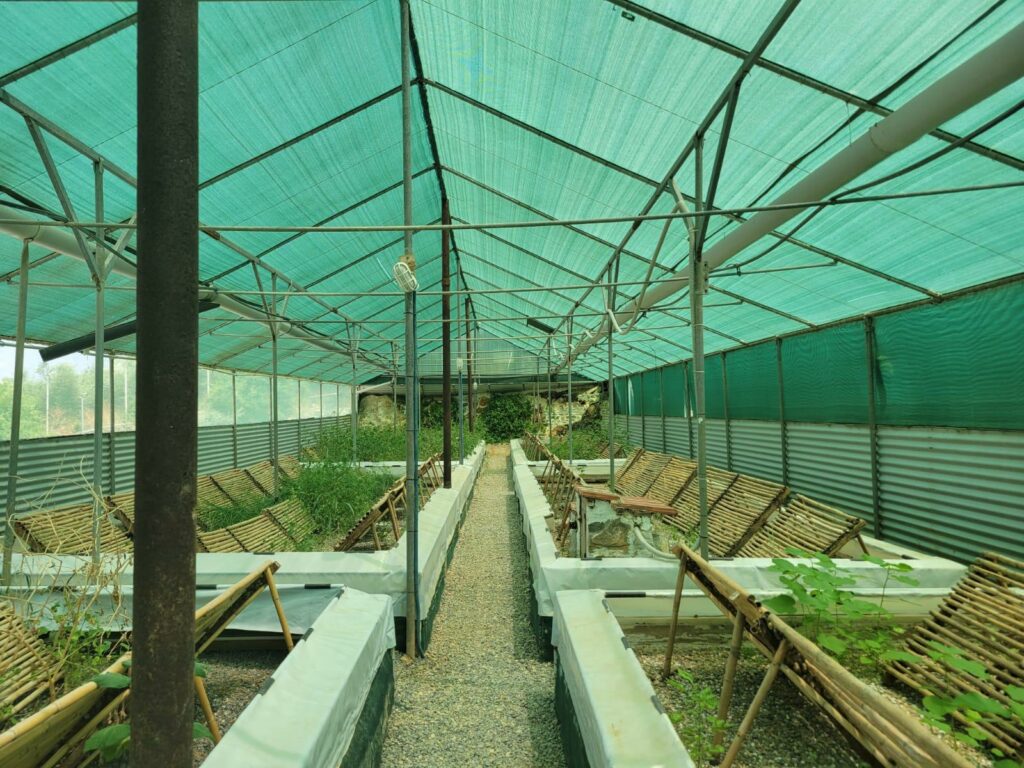
The snail enclosure was a long shed, with irrigation pipes designed for misting all above us in a grid. Under the green filtered light through the plastic siding, I saw rows and rows of V-shaped structures made of what I guessed was bamboo, the rungs spaced out an inch or so apart on each structure. There were about six long planters, with each planter containing about seven wooden structures, nestled amongst dirt and vegetation. Vaso led my sister and I down the gravel path in the snail enclosure until we came to the center, where she told us that, unfortunately, we wouldn’t see much snail activity that day. I asked her why that was, and realized that I had not actually seen any snails since I entered.
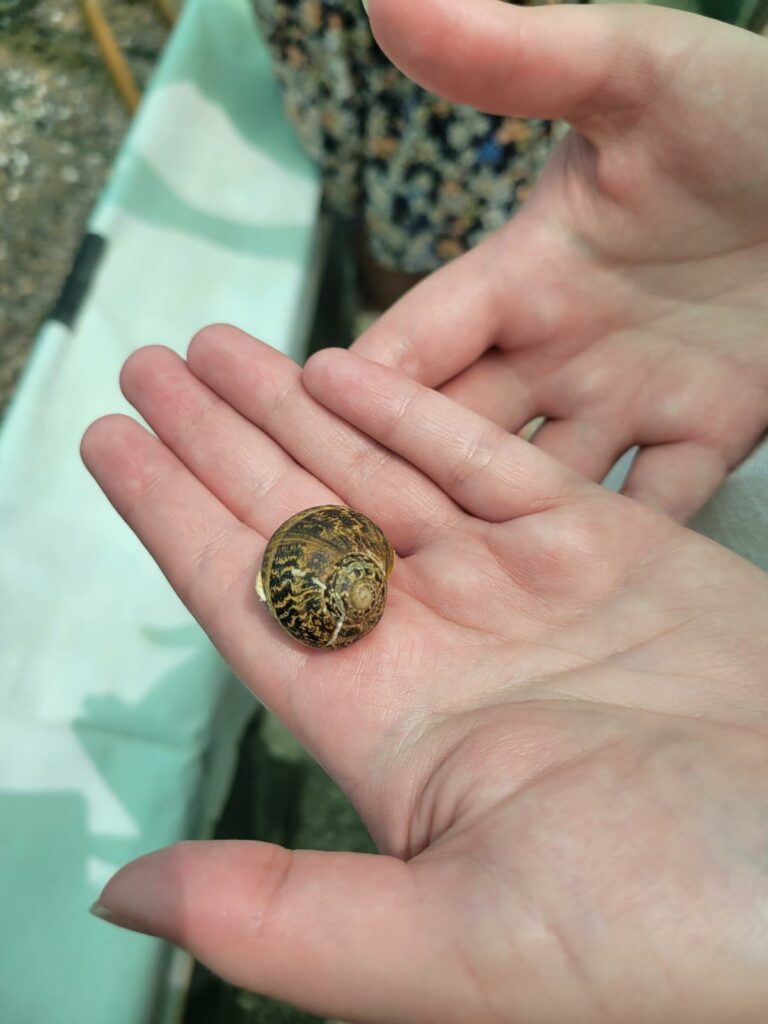
It was then that Vaso bent over and plucked what I thought was a stone from within the floor of one of the planters, and held her hand out to me. Sure enough, what I had assumed to be a rock was in reality a snail shell.
“They shed their shells, like hermit crabs?” I asked.
“No. This is their hibernation period. Look,” Vaso said, and flipped the shell over. Where I had expected a tiny, gelatinous body, was a hard, firm membrane covering the hole of the shell. “Snails actually hibernate from May to September, and as they sleep they add layers to the membrane. It protects them as they rest. You can tell how long they’ve been sleeping by how thick the membrane is.” To demonstrate this, Vaso pushed on the membrane of the snail in her hand until it came away, and held it up to show us the thickness of it. She pocketed the snail to cook it later, as it would not be able to reseal itself.
The Cretan people have a rich history of using snails as food dating back to the ruling Minoans. Though many consider snails a delicacy, the Cretans were kept alive by snails during periods of political turmoil and famine. When the Minoans starved after their civilization collapsed, they were not only able to survive on fish, but the snail. During World War 2, when Crete was occupied by the German army, the people of Crete staved off starvation by eating wild snails. They are a staple of Cretan cuisine, and many snails used by restaurants are still sourced from the wild. Farmed snails are often exported to restaurants on the mainland, where Cretans who have since migrated still crave the flavor of home. The spiral of the snail shell became prominent in Cretan art and jewelry, becoming a symbol of life, eternity, and synonymous with the famed Labyrinth of mythology.
You can imagine the awe with which I stared at the little thing sitting squarely in Vaso’s palm as she told me all of this. I had never put much thought into the creature’s existence before that day, but I realized that, ironically, this little invertebrate was the backbone of a people.
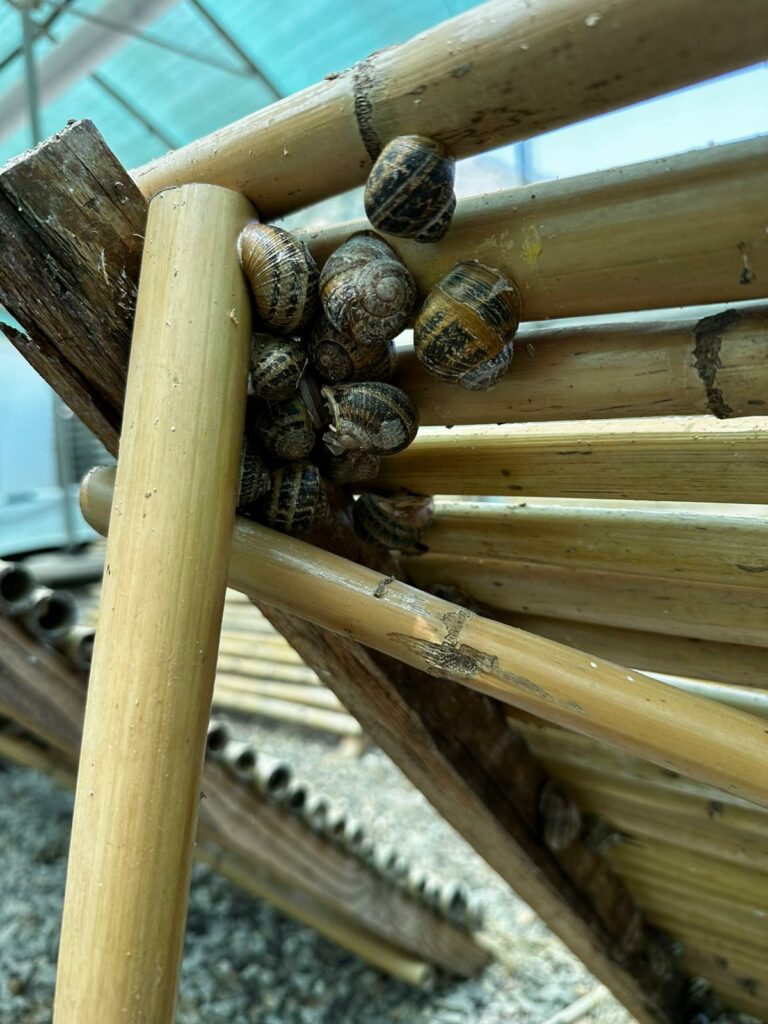
Vaso pointed to the clusters of snails that lay on the ground around the poles and clung to the underside of the V-shaped structures. She told us that snails tend to group together when they hibernate for protection, and in the wild hibernated together on the barks of trees where they will be camouflaged. The enclosed green snail house acted in a similar fashion to protect the snails from threats of birds or slugs that could take advantage of them at their most vulnerable.
“Slugs eat snails?” I asked, shocked that a creature I assumed was related to snails would so brutally turn on its brethren.
Vaso emphatically insisted that they do, and that they were not, as I had ignorantly assumed, brethren at all. Slugs are often a worse predator for snails than even larger animals, gooey terrors that they are. Vaso then pointed out the tiny white circles I had mistaken for gravel and showed me that they were, in fact, snail eggs. Snails are hermaphrodites, and after mating both parents lay a clutch of anywhere between 60-100 eggs. It takes a snail 30+ hours to lay a clutch, during which the snail is vulnerable to attack, (and I was beginning to question when they weren’t vulnerable, for all the good their shells do them). The infant snail grows exponentially, growing from the size of a pinhead to a pinkie nail in less than a year. Their shells, which they are born with, act like a tree stump, in that you can tell the age of a snail by how large their shells grow.
My sister then asked about the diet of the snails, and Vaso explained that they eat mostly vegetation, but are extremely picky. For one, snails will refuse to eat food that is red. If they eat apples, or even eggplants, they must be cut open, and even then the snails only eat the white fruit inside. They will not touch the skin at all. Her snails have a distaste for spinach, and most herbs, but make an exception for parsley. And she’s noticed, through years of trial and error, that their favorite food is zucchini.
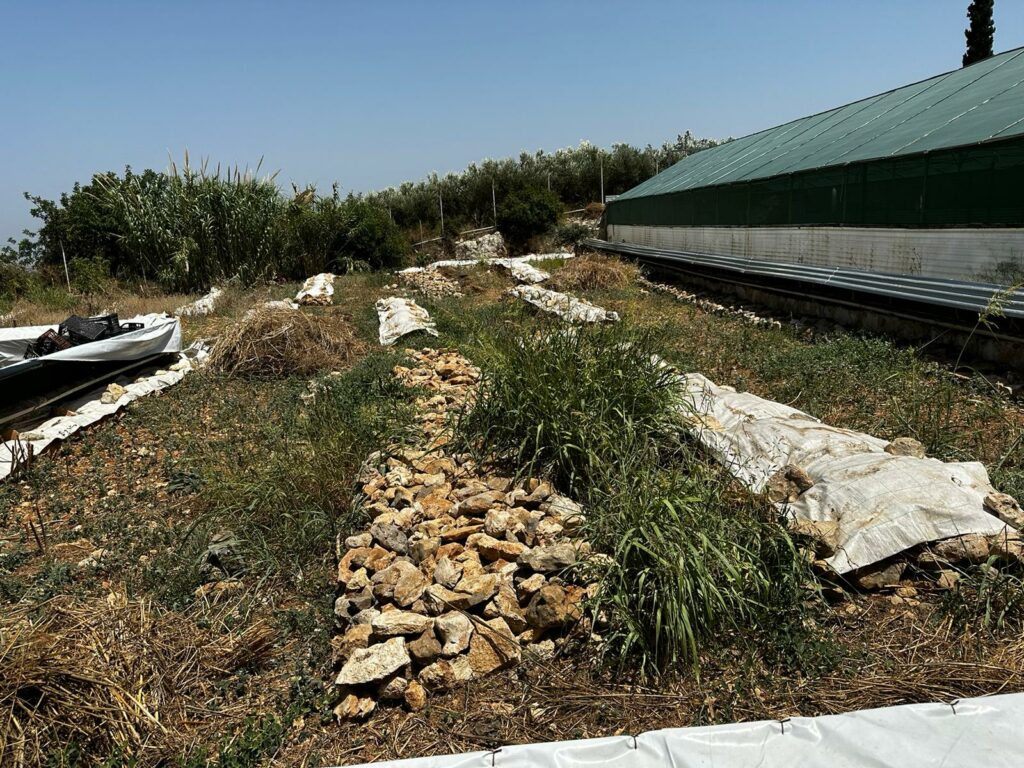
The love Vaso has for her snails is apparent when she gives you this tour. She and her husband have been farming snails for 13 years, and they constantly experiment with finding the best ways to help enrich the lives of their ‘livestock.’ For the past three years, in fact, Vaso has taken to moving her snails to an outdoor enclosure just next to the building where they hibernate, so that they may spend their waking hours in an environment as close to nature as possible. There they can explore rocks and vegetation, eat, exercise, and even mate. Vaso says that, like cows, the act of going to a kind of pasture is enriching, and though they don’t possess enough neurons to truly ‘feel,’ it makes the snails seem happier. And happier snails lead to a better crop.
Vaso’s farm exports anywhere between 2 and 2.5 tons of snails a season, (as snails do, in fact, have a season). In order to keep farming, she must keep at least 200 kilos of snails in order have enough of a population to make more snails. Vaso explained that you have to wait a couple of years before the snails are ready to eat, as they must be big enough to be sustainable. Though the previous two seasons had not been as good as they’d hoped, Vaso and Stavros still loved their snails, their farm, and had hope that this season would be better.
After the tour, we spent a brief period enjoying the shade and the cicadas with our hosts, who offered us a refreshing glass of water to take the edge off of the oppressive heat. We chatted about life and mundane things for a while, until two additional families arrived, eager and excited to see the snails. My sister and I stayed briefly to finish our conversation with Vaso and Stavros, but though we were welcomed to stay and relax while Vaso gave her next tour, we declined and let her get back to work. Before I left I confessed to Vaso that I was a writer, and I asked permission to write about her farm. She consented, and we laughed together about how I had been acting as a ‘spy’ all afternoon. As I drove away, I felt contentment coupled with a deeper appreciation not just for the Cretan snail, but for the warmness and kindness of the Cretan people.
Snail Farm and Fun was one of the most incredible experiences I had during the 2023 summer, and it wasn’t just because I learned about the fascinating life of a snail. It was more so that I had gained a deeper appreciation for the little things that exist on this earth, thanks in large part to the hospitality I experienced at this snail farm. I realized that this farm exemplified what was special about Crete: A wonderful conversation between strangers at a snail farm, a moment in the shade, a smile… and yes, the snails. Importance, in truth, is stored in the little things.
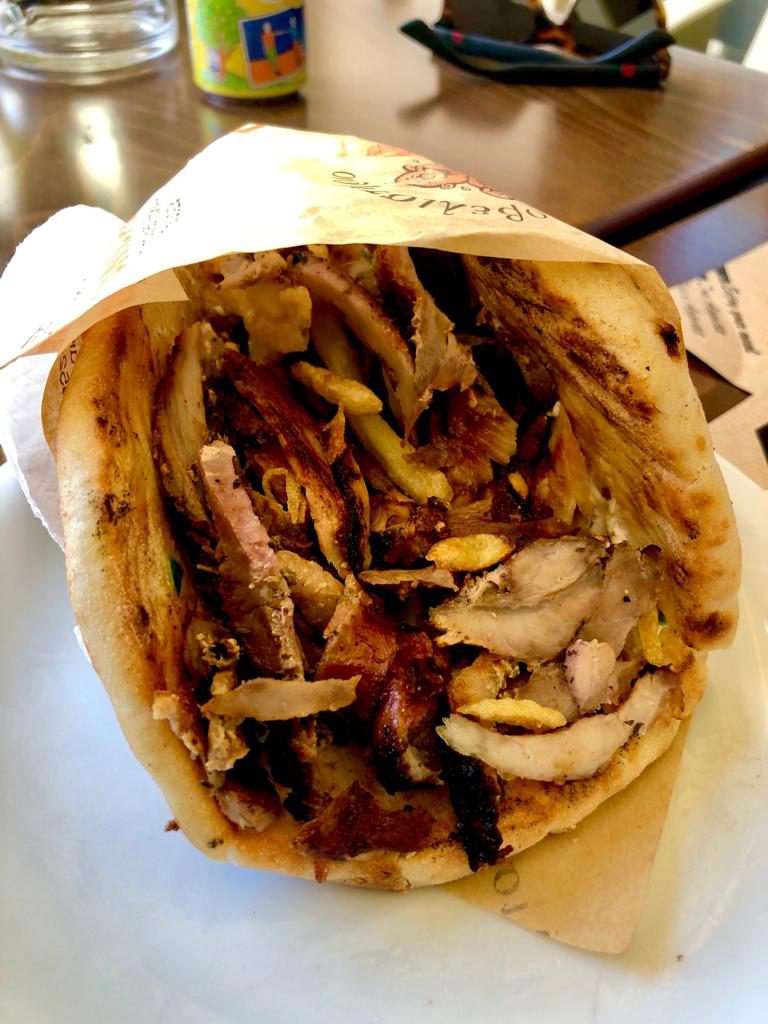
If I asked you what the quintessential Grecian food was, you’d probably run the usual gamut of foods: moussaka, grilled octopus, stuffed grape leaves, lamb, all wonderful examples of the deliciousness of Greek cuisine. But I would be remiss in my duties as a travel blogger if I didn’t take a moment to exalt the wondrous gyro. Perhaps places other than Greece have made the gyro seem commonplace. The first few years of my life, I only ever got gyros from fast food joints that didn’t exactly put any extra time or attention into their meat. Are you supposed to expect craft from them? I didn’t, and my lack of expectations led to a life of thinking that my neighborhood junk food place could provide me with a satisfyingly enough gyro that probably tasted the same all over the world. But if you, as readers, have not learned anything from my chronicles, you can guess that my first assumptions of these things are usually proven wrong. It’s almost my modus operandi: make a seemingly educated guess, get immediately proven wrong.
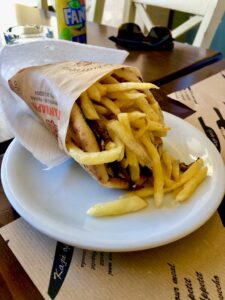
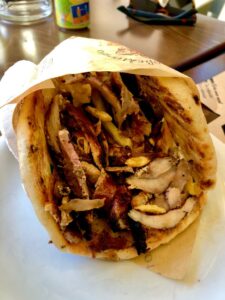
The gyro in all its glory!
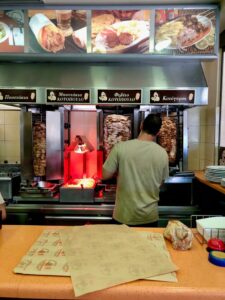
If you have been so unfortunate as to not know, let alone experience, the deliciousness of a gyro, allow me to make you pine wistfully for this sweet, sweet food. Gyros are usually made with pork, (though chicken or even lamb are sometimes alternative options), which is seasoned, sliced and stacked to form a cone. Then, as the name suggests, the cone is cooked using a vertical rotisserie, and pieces are sliced off of the cone and into a pita, along with onions, tomatoes, fries, and tzatziki. It’s a heavenly food that really hits the spot when you’re on the hunt for something quick, delicious, and not a cheeseburger. It’s moist, crisp, and full of flavor. But in a place where gyros are plentiful, to say the least, where should you turn to get the best one?
You spin me right ’round baby right ’round like a meat cone…
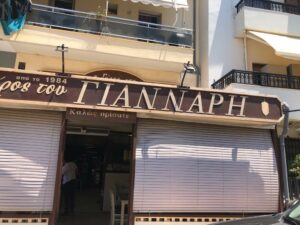
I was introduced to O gyros tou Giannari by my cousin, who, upon picking me up from the airport one visit, announced that he had found the best gyros on the island. I wasn’t skeptical. My cousin knows everyone and everything that happens on Crete, so I was optimistic that the gyros were delicious. I wasn’t sure that they’d be the best, but I had no doubt that they’d at least beat what I could get back home. I told my cousin I’d be more than happy to go get gyros when I wasn’t suffering from jetlag, but the rest of the family, who’d arrived days before me, wanted to surprise me with food and were already waiting for me at the restaurant…so off we went.
It’s here. Here’s where you’ll get the best gyro in town.
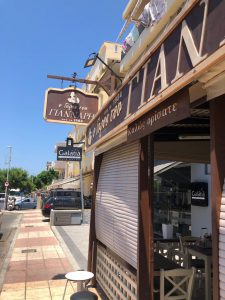
O Gyros tou Giannari, (or O γύρος του Γιάνναρη if you’re reading it in the Greek alphabet), has a pretty unassuming front. It’s not exactly easy to get to if it’s your first time trying to navigate the less touristy areas of Heraklion, but don’t be scared off. If you’ve got google and a GPS, you’ll handle yourself just fine. You’ll know you’ve made it when you come across a tawny awning, that also happens to have a cartoon baby as it’s mascot. No, I’m not sure why the baby is part of the brand. I never asked. The baby is happy to be there, gleefully devouring a gyro, perhaps a sign that you too shall soon be in the throngs of the kind of enthusiasm about food that you used to have, as a small child. Or maybe I’m reading too much into it and there’s just a baby mascot. Don’t dwell on it.
Can you see the baby mascot? He can see you…
It’s a simple enough place on the outside, a few tables and chairs sit under the enclosed awning, with a fridge full of drinks that you can grab at your discretion, (though it should be noted, they are not free). The inside is smaller, though it has a few tables, and along the very back has a wall lined with puzzles, games and brainteasers for families with children, (or perhaps those whose inner child really wants to solve a wooden Rubik’s Cube). It’s a cozy, family-owned operation that takes great care with their preparation, ingredients, and their customers. It should be noted that, when I arrived at the restaurant, my party was quite large, at least for Europe: we were six in total. Despite the hassle that can come with a larger party, the restaurant and staff was incredibly kind and accommodating for all of us, with impeccable service to match. (In turn, my family and I tried to be as helpful and out of the way as we possibly could).
An interior view
Though there’s a variety of foods you can order at Giannaris, I recommend one of two things: the pork gyro or the chicken gyro. Sure, grab a salad while you’re there, if you’re feeling a bit health conscious. Down some beer. Order some fries. But know, in your heart of hearts, that you’re here for one thing: the best gyros on the island. I am not exaggerating. I do not know what Giannaris uses to make their pork and chicken so perfectly seasoned, nor do I know exactly how long they allow their vertical rotisseries to rotate before they begin to slice off their meat, which is perfectly balanced between moist and crispy. All I know is that their gyros are the most mouthwatering food I’ve had in ages, a heavenly pocket of meat, veggies, fries, and tzatziki. Did I not mention that they include perfectly cut and cooked fries in their gyros? It’s one of the multitude of things that this place does better than all others on Crete. I don’t tend to pursue a French fry when I’m in a foreign country, but the fries inside a Giannaris gyro are some of the most incredible fries I’ve ever eaten. It’s a perfect compliment to the meat and sauce within, and boy do they stuff them in there. You may be forced, like my mother was, to remove some of them and eat them separately. Personally, I find this a cowardly action: unhinge your jaw, and make sure you can taste all of that meat, tomato, fry, and tzatziki in a single bite. Think of it like sushi, how every ingredient in a roll is there to perfectly complement each other, creating a burst of flavor and the exact mouth feel you expect from the food. This is what a gyro should be.
God’s gift
Giannaris is a gift from God to Crete, the world, and to me especially. Even now I’m salivating as I remember that sweet, sweet first bite. I hadn’t known that gyro meat could taste that way before, perfectly crispy without being overcooked, moist without being under-cooked, the perfect amount of tzatziki (which is a lot), complete with a cooked pita instead of a cold one. My eyes have since been opened, but in some ways I bemoan this. It was as if I had tasted from the fruit of the forbidden tree in Eden, and now I have been cast out upon learning something I shouldn’t have. I spend many of my days back home dreaming of my next trip to Crete specifically so I can purchase these gyros for twelve straight days. I think I may have driven my family a little crazy asking for them almost daily, and on days when I could not have them, I knew then why women in Victorian England could take sick and die all because they were separated from the one they loved.
I’ll tell you a true story: my cousin has a young daughter, who loves these gyros as I do. One day, as my cousin was driving her home from school, she started to display signs of illness, holding her stomach and moaning. Understandably concerned about his little girl, my cousin pulled over.
“What’s wrong?” He asked. “Are you sick?”
“Yes,” she said gravely.
“What do you need?”
“I need……a chicken gyro…..”
“What?!”
“I need a chicken gyro.”
Though I cannot imagine the strange mixture of parental relief and irritation, I smile thinking about this incident all the time. And, if you’re wondering…yeah, she got her chicken gyro. It was the only thing that would make her better, after all.
Those who know me best know that I am unable to resist a kitschy tourist trap when I see one. I can’t help it: the minute I know it’s there, all of my mature appreciation of art and culture flies right out the window, and all of my thoughts are consumed by an almost primal desire to do something dumb for the sake of the doing it. I can’t even claim that it’s done ironically: I genuinely enjoy exploring tourist traps. I love finding joy in roadside attractions, in things that may be more expensive than they’re worth but are nevertheless enjoyable, in things that, while on the surface a dedicated traveler may consider a waste of time, I consider an experience. I’m reclaiming my joie de vivre one wacky, weird thing at a time.
Which is how I came to be a patron of the Doctor Fish spa.
How could something so…relatively…cute be so flesh-hungry?
It is, as the name suggests, a fish spa. I had never heard of such a thing before, and had never even seen one in America, (although some people have informed me that they do indeed exist). The premise is this: the unsuspecting tourist, lured into the spa by the employees looking for anyone who’ll bite, is asked to first rinse their feet off in a sort of shower. Once they’ve rolled up their pants and handed over their sneakers, the tourist awkwardly climbs up onto a padded bench and unceremoniously dips their legs into tank containing twenty or so relatively small fish. For the next fifteen minutes, your legs are suspended in water, as these fish nibble the dead skin away. After your time is up, you awkwardly waddle back to the shower, wash your feet, and go about your day. The end result is supposed to be that, now all the dead skin on your calves and feet has been eaten, your skin has been exfoliated and is silky smooth. Bizarre? Yes. Hygienic? Possibly. The jury is still out. Just weird enough for me to want to try it? Of course.
To some, a nightmare. To me, an adventure. But also a bit of a nightmare.
For months, I had seen the store, as I had to walk past the place in order to get to Heraklion’s pier. I would walk down the main thoroughfare, glancing at it wistfully. Every time I asked my family if they’d like to try it out, they looked at me as if I had asked if they had wanted to try some sweet bread. It wasn’t easy, as I walked up and down this street often, buying souvenirs for friends. Each time I passed by the fish spa, the employees working the crowd would lock eyes with me. They knew. They could see it in my eyes that I wanted to enter, and they used that to their advantage. But alas, I couldn’t cave to my desire to stick my feet in a bucket of fish. I had places to go, people to see. The fish spa…would wait.
And then the end of my Summer arrived, and I found myself full of the usual bout of end-of-vacation blues. I didn’t want to leave the crystal-clear Cretan waters, the sunshine, and the like. I didn’t want to give up gyros and freshly cooked lamb. I was in a slump, and only one thing could lift my spirits: a final high note, one last ride, one final experience that would be the cherry on top to my Summer. The fish spa’s hour had come. That afternoon, my family and I headed to the fish spa, not quite sure what we were in for, but aware enough that we were going to have…a time.
Let me start by saying, don’t wear a dress to the fish spa. Climbing awkwardly up a bench that’s just a little too high for you, only for you to need to scoot down the bench to your allotted tank, makes a dress a hindrance. Secondly, definitely go with other people. Bring friends, family, distant cousins, acquaintances you made on your cruise, your yiayia, what have you. It is so much more fun going with people than by yourself. Not only does it distract you a little from the agonizing tickling sensation around your feet, it is the highest form of entertainment. I have three or four videos stored forever in my phone, which I watch sometimes when I’m feeling down, of my mother on the verge of screaming as the fish tickle her relentlessly. My brother mocks her mercilessly, bragging about how the fish’s tickling hasn’t troubled him in the slightest, while my sister and I have cast aside decorum and burst into uproarious laughter. Two random strangers in the video stare at us like we have grown three heads. It’s one of my favorites.
Pictured: my friends and family suffering at the behest of my whimsy
I was aware the feeling would not be…comfortable, but I wasn’t prepared for how strange it would feel. The farther up your leg the fish latch onto, the easier it is. They’re tolerable, those fish, the chill dudes of the tank. I liked them. They didn’t activate my fight or flight response. The fish that latched on to the top or sides of my actual feet were on thin ice. There was definitely a strong sense of discomfort produced by their presence, but those weren’t the ones that sent me into peels of tickle-induced laughter. That honor went to the little bastards who targeted my toes. If you’ve ever wanted to know just how strong your stoic endurance can last, buy yourself a fifteen-minute session at a fish spa, and see how long you can keep a straight face. Extra points if you can keep yourself from squirming. I think the hardest part of the whole thing was forcing my legs to stay still, instead of kicking them about like instinct demanded. But I survived, as did my poor mother, who vowed to never visit a fish spa again.
I’m suffering, but I’m also living my best life
I didn’t stick around for a manicure, which was one of the many other spa services Doctor Fish offered, but the next Summer I visited Crete, I went back to the spa twice. What can I say? There’s a satisfying kind of schadenfreude that comes from bringing your friends to a torturous fifteen minutes at the fish spa.
Oh, and my skin? Perfectly exfoliated. Beauty isn’t pain…it’s a swarm of tickling fish.