Tag

greece

Browsing

It’s almost Valentine’s Day and love is in the air. Pink and red hearts dot the counters at the grocery store, candy hearts and teddy bears sit expectantly in the aisles for the boyfriends who put off shopping too long. Assorted boxes of chocolates, some better than others, are stocked on shelves, and couples everywhere eagerly book reservations for date nights they’ll be sure to remember. We love to celebrate Love with as much gusto as the emotion evokes…so how do we celebrate love in Greece? This Valentine’s Day, let’s dive into some of the more romantic traditions and myths of the Greek people just in time for a candlelit dinner.

Cupid

I would be remiss if I did not explore the origins of Cupid himself on Valentine’s Day, especially since tiny, winged babies often flit through the various paper décor one is accustomed to seeing halfway through February. Perhaps those unfamiliar with the myth would be surprised to learn that the Greek version of Cupid is not, in fact, a cherubic baby, frolicking about as he shot his arrows of love into the unsuspecting blessed.
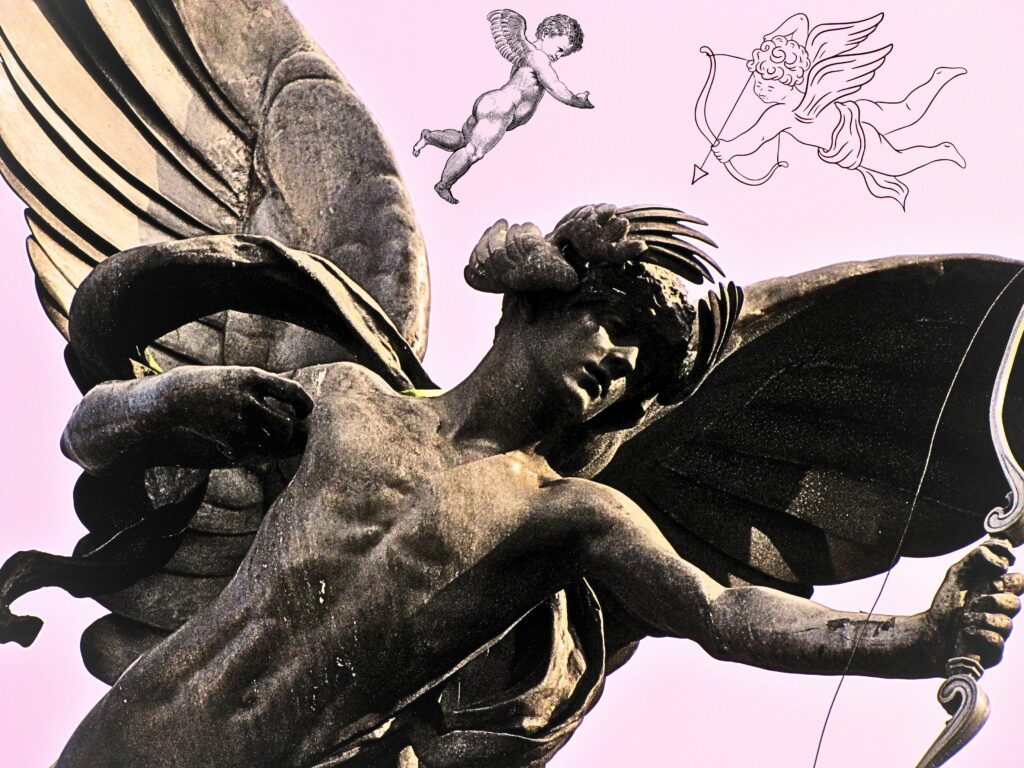
eros or cupid

In Greek myth, Eros was the god of love who held dominion especially over the realm of the ‘erotic’. A true lover of chaos, Eros shot his magical arrows at his pleasure to drive people mad with lust, desire, and even love, usually to disastrous results, be it mutual or one-sided. Occasionally, animals would even get thrown into the mix, though cases like this would more often than not be a punishment Eros (or his mother, Aphrodite) had deigned to give. Perhaps this is why love brings us just as much pain as it does pleasure, for Eros’ involvement in mortal lives was extremely chaotic.  His very name translates to ‘desire,’ which is no surprise when you think of the madness such desire instills in each of us.  It wasn’t until his marriage to Psyche, who would become the goddess of the soul, that the chaos of love was balanced with the equal power of the human spirit, (a fantastic story for Valentine’s Day where love truly conquers all, especially in-laws).

So how do we get a tiny, cherubic baby named Cupid from the god of erotic love and desire? As per usual, the answer lies with the Romans. In an effort to distance themselves from the power love held over humanity, the did the only thing they could: they infantilized him. Where Greeks acknowledged, in spite of themselves, the madness that took hold of humans in love, the Romans sought to reduce his power. Suddenly, Eros-Now-Cupid was merely a mischievous child acting purely on behalf of his mother Venus rather than a powerful and independent god who did what he did for the love of the game, who only occasionally acted on his mother’s behalf. Love was tamed, adorable even, and generally more digestible to a people who invented the philosophy of stoicism. Love was not a punishment or madness, but a pleasant reward delivered to us on tiny baby angel wings that could be ignored if one really tried. Cupid has remained in the popular consciousness ever since as the cherubic figure who delivers sincerity and light mischief rather than the all-consuming flame of love.

Personally, I prefer the chaos of Eros, but that might just be the Greek in me.

Argyrobounialaki

In many countries, proposals look much the same. A man gets down on bended knee to hold out a diamond ring while overlooking the seaside, or the top of a mountain, or wherever a couple’s love holds the strongest memories. Done right, a proposal is a genial memory that perfectly happy couples can look back on with fondness, perhaps especially on days where reflecting on the love they share is encouraged.

But on Crete, sometimes, love can cut like a knife.

Visitors to Crete might be familiar with the significance of the Cretan dagger, which has held cultural importance to the people of the island for centuries. Today, the artisans who still craft these knives authentically are mostly based in Chania, where it may be your only chance to find authentic argyrobounialaki.
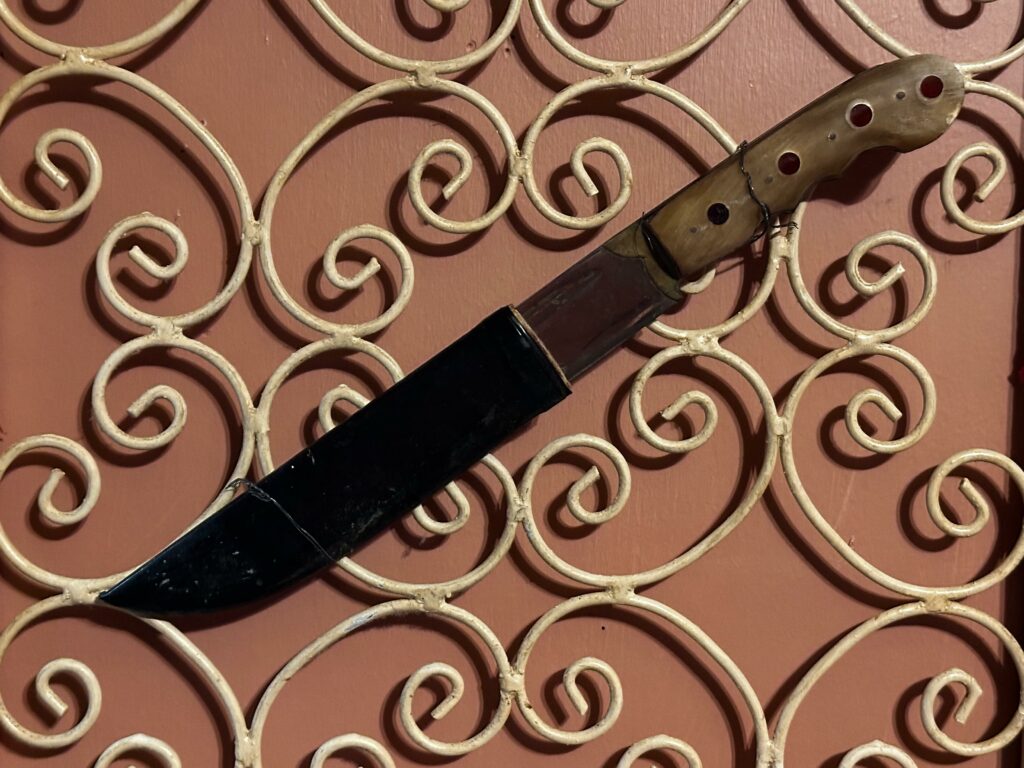
cretan dagger wine dark sea villas

For centuries, men on Crete did not propose with a ring, but instead presented their future brides with a small, silver dagger known as an argyrobounialaki. These daggers were small but still sharp, and sometimes engraved with a name or short poem, (with certainly more space than an engraved engagement ring). The future bride would wear the dagger tucked into her sash around her waist for all to see, just like the men of her village would wear their own daggers. The purpose of the dagger was three-fold, the first and most obvious being that it was an outward symbol of the engagement. A ring may not be noticed at first glance, but a knife tucked into a sash is harder to miss. The second, and perhaps more somber reason, was that it served as a reminder to the woman that, should she be unfaithful to her future husband, she would have no alternative but to die, whether at her own hand or at the hands of the man. However, the third reason was an act of empowerment: the bride-to-be was now given the agency to protect herself should she be placed in any danger, and her wearing the knife signified to those who wished her ill that she could and would defend herself.

At times equal parts cruel and empowering, the ceremonial dagger was a staple of Cretan celebrations of marriage for centuries. Though it has since been replaced (for the most part) by the more well-known custom of giving engagement rings, the Cretan dagger has remained an important cultural touchstone in all facets of life, from engagements to marriages, folk magic and ceremonies of all kinds. After all, there’s something about receiving an engagement dagger that makes for a memorable start to a marriage.

February and Valentine’s Day
ancient greek wedding preparation

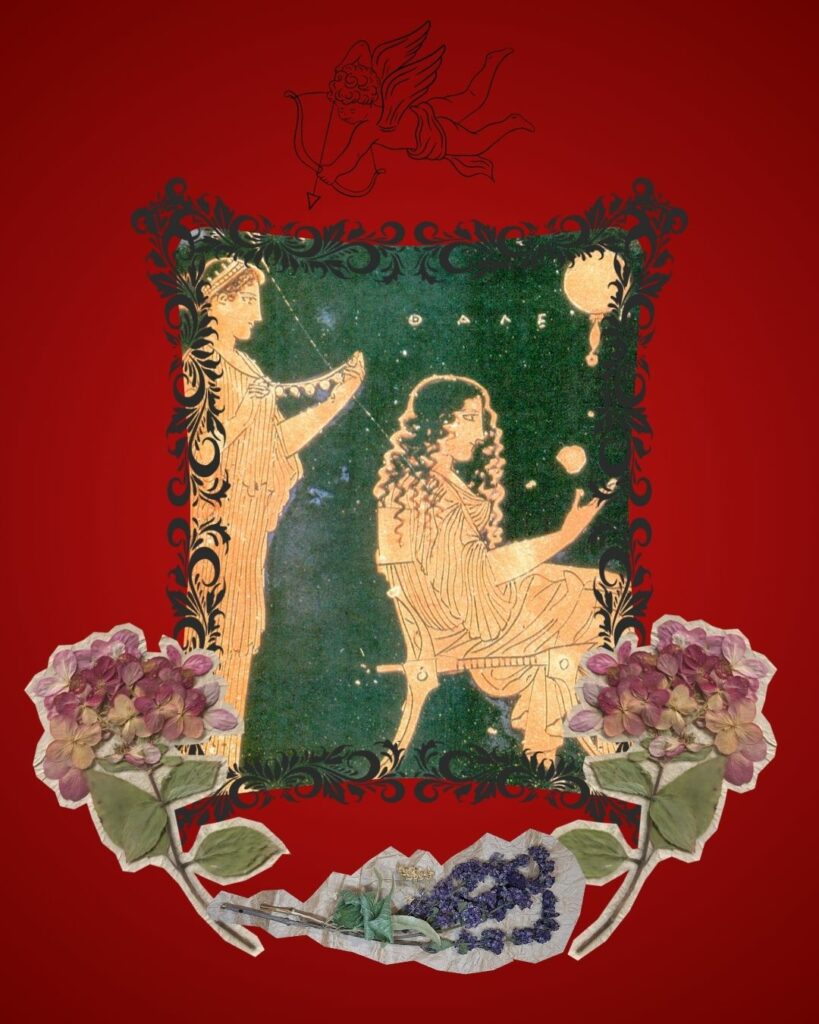
So why is it that Valentine’s Day falls during the month of February, anyway? I’ve always wondered why one of the coldest months of the year is so closely associated with celebrating love, and more often than not the answer I got was that Lupercalia, the Roman festival of fertility, was celebrated on the modern equivalent of February 15th. However, the ancient Greeks, as seems to be the case, were first to establish the month as a season of love: in their calendar, this seventh month of the year was called Gamelion, and was known as the marriage month. Perhaps because of the proximity to spring, or perhaps because the days were warmer while the nights were cold in this month, but Gamelion, not June, was the month everyone in the ancient world aimed to celebrate their wedding. Today, no wedding on Crete is complete without a fireworks display, which may seem like going all out until you compare it to their Ancient Greek counterparts, who celebrated their weddings for three festive days of partying and making sacrifices to the goddess of marriage, Hera. Though less about true love and more about arranging advantageous connections between families, that didn’t stop the ancient Greeks from throwing the ultimate wedding party.

Perhaps, in that respect, not much has changed for Greece.

Of course, our modern celebration is not due to the timing of Gamelion, but a coincidence. Though St. Valentine is not recognized within the Greek Orthodox church, everyone with a ‘Valentine’ variation to their name still celebrates their Name Day during this time. Perhaps it was fate that the Catholic Patron Saint of Love was executed on February 14th, (though there is more than one Saint Valentine, and the island of Lesbos claims to hold sacred relics of at least one of them), bridging this strange gap across time and religion to cement the month of February as our time to remember the importance of love in our lives.

A strange coincidence, to be sure, but one that certainly gives me pause as to the connectedness of the history of humanity.

In Conclusion

There are many more myths and customs to be explored when it comes to the celebration of love, but for now I shall leave you here. There is much to revisit come next Valentine’s Day, perhaps as many stories and customs are there is love in the world. To you, dear reader, if you’re wondering whether or not to engage in any kind of festivities this coming weekend, go on: read some old love stories, consider some less conventional ways of showing love, and embrace the spirit of the day no matter your relationship status.

Love is more than enough reason to celebrate.

By Katarina Kapetanakis
Those who know me best know that I am unable to resist a kitschy tourist trap when I see one. I can’t help it: the minute I know it’s there, all of my mature appreciation of art and culture flies right out the window, and all of my thoughts are consumed by an almost primal desire to do something dumb for the sake of the doing it. I can’t even claim that it’s done ironically: I genuinely enjoy exploring tourist traps. I love finding joy in roadside attractions, in things that may be more expensive than they’re worth but are nevertheless enjoyable, in things that, while on the surface a dedicated traveler may consider a waste of time, I consider an experience. I’m reclaiming my joie de vivre one wacky, weird thing at a time.

Which is how I came to be a patron of the Doctor Fish spa.

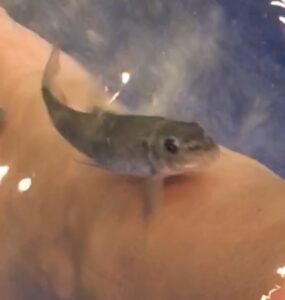
How could something so…relatively…cute be so flesh-hungry?

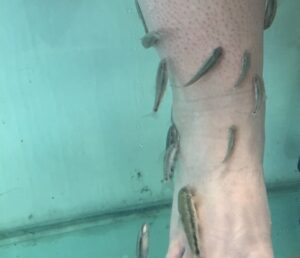
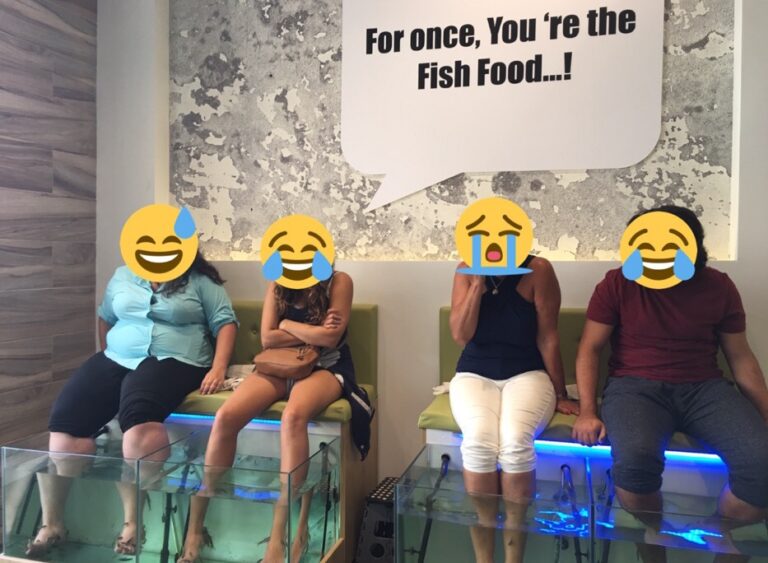
It is, as the name suggests, a fish spa. I had never heard of such a thing before, and had never even seen one in America, (although some people have informed me that they do indeed exist). The premise is this: the unsuspecting tourist, lured into the spa by the employees looking for anyone who’ll bite, is asked to first rinse their feet off in a sort of shower. Once they’ve rolled up their pants and handed over their sneakers, the tourist awkwardly climbs up onto a padded bench and unceremoniously dips their legs into tank containing twenty or so relatively small fish. For the next fifteen minutes, your legs are suspended in water, as these fish nibble the dead skin away. After your time is up, you awkwardly waddle back to the shower, wash your feet, and go about your day. The end result is supposed to be that, now all the dead skin on your calves and feet has been eaten, your skin has been exfoliated and is silky smooth. Bizarre? Yes. Hygienic? Possibly. The jury is still out. Just weird enough for me to want to try it? Of course.

To some, a nightmare. To me, an adventure. But also a bit of a nightmare.

For months, I had seen the store, as I had to walk past the place in order to get to Heraklion’s pier. I would walk down the main thoroughfare, glancing at it wistfully. Every time I asked my family if they’d like to try it out, they looked at me as if I had asked if they had wanted to try some sweet bread. It wasn’t easy, as I walked up and down this street often, buying souvenirs for friends. Each time I passed by the fish spa, the employees working the crowd would lock eyes with me. They knew. They could see it in my eyes that I wanted to enter, and they used that to their advantage. But alas, I couldn’t cave to my desire to stick my feet in a bucket of fish. I had places to go, people to see. The fish spa…would wait.

And then the end of my Summer arrived, and I found myself full of the usual bout of end-of-vacation blues. I didn’t want to leave the crystal-clear Cretan waters, the sunshine, and the like. I didn’t want to give up gyros and freshly cooked lamb. I was in a slump, and only one thing could lift my spirits: a final high note, one last ride, one final experience that would be the cherry on top to my Summer. The fish spa’s hour had come. That afternoon, my family and I headed to the fish spa, not quite sure what we were in for, but aware enough that we were going to have…a time.

Let me start by saying, don’t wear a dress to the fish spa. Climbing awkwardly up a bench that’s just a little too high for you, only for you to need to scoot down the bench to your allotted tank, makes a dress a hindrance. Secondly, definitely go with other people. Bring friends, family, distant cousins, acquaintances you made on your cruise, your yiayia, what have you. It is so much more fun going with people than by yourself. Not only does it distract you a little from the agonizing tickling sensation around your feet, it is the highest form of entertainment. I have three or four videos stored forever in my phone, which I watch sometimes when I’m feeling down, of my mother on the verge of screaming as the fish tickle her relentlessly. My brother mocks her mercilessly, bragging about how the fish’s tickling hasn’t troubled him in the slightest, while my sister and I have cast aside decorum and burst into uproarious laughter. Two random strangers in the video stare at us like we have grown three heads. It’s one of my favorites.

Pictured: my friends and family suffering at the behest of my whimsy

I was aware the feeling would not be…comfortable, but I wasn’t prepared for how strange it would feel. The farther up your leg the fish latch onto, the easier it is. They’re tolerable, those fish, the chill dudes of the tank. I liked them. They didn’t activate my fight or flight response. The fish that latched on to the top or sides of my actual feet were on thin ice. There was definitely a strong sense of discomfort produced by their presence, but those weren’t the ones that sent me into peels of tickle-induced laughter. That honor went to the little bastards who targeted my toes. If you’ve ever wanted to know just how strong your stoic endurance can last, buy yourself a fifteen-minute session at a fish spa, and see how long you can keep a straight face. Extra points if you can keep yourself from squirming. I think the hardest part of the whole thing was forcing my legs to stay still, instead of kicking them about like instinct demanded. But I survived, as did my poor mother, who vowed to never visit a fish spa again.

I’m suffering, but I’m also living my best life

I didn’t stick around for a manicure, which was one of the many other spa services Doctor Fish offered, but the next Summer I visited Crete, I went back to the spa twice. What can I say? There’s a satisfying kind of schadenfreude that comes from bringing your friends to a torturous fifteen minutes at the fish spa.

Oh, and my skin? Perfectly exfoliated. Beauty isn’t pain…it’s a swarm of tickling fish.


By Katarina Kapetanakis 

I am not a person who usually craves bananas. Maybe I just tend to contain the recommended daily dose of potassium naturally, and have never needed to seek it out from an outside source. Or maybe I just don’t crave bananas. That’s not that weird. I enjoy a good banana milkshake every now and then, and those little fruit-shaped candies that come from vending machines that are shaped (but most certainly do not taste) like bananas are fine, and banana bread is great! But I don’t seek out bananas like I do other fruits, and I’m perfectly okay with that. This is just how my life is, I assumed. Some people are banana people, and some just aren’t. I fell into that latter category for no other reason than it just happened to be how life was.

My cousin said it was because I’d never had a decent banana.

“You have never tried bananas like the ones near Vai.”

“The beach?”

“Yes. There is a man who has a fruit stand, right before the turn to go to the beach. He sells the most delicious bananas in the world.”

“Those must be some bananas.”

“You have to taste it to believe it,” he said. “He always sells out early.”

“So, you’re saying that there’s always money in the banana stand?”

My cousin didn’t get the pop culture reference, but that was alright with me.  I wasn’t exactly foaming at the mouth for those curvy yellow fruits, but I didn’t mind taking fresh fruit to the beach. I was also very excited to visit Vai, which I had heard was an incredible beach, but is, alas, a story for another time. If you think I can’t tell an entire story about a banana stand and how the banana man thwarted me, you’d be wrong. So wrong.

The drive to Vai was about an hour and a half from where I was staying on the island of Crete, enough time for me to observe the beauty of the natural landscape of the place, and take some blurry photos on my phone. I slumped back into my seat after about fifteen minutes of failed photography, (though I guess, with the right filter, it could have been hipster-Instagram worthy), and closed my eyes. Car rides longer than 20 minutes will put me right to sleep, and the lull of the van as we rose and fell and curved with the land was the perfect sedative. I felt blissfully at peace, with the sunlight floating through the crack of the open window; if I had been a cat, I couldn’t have been happier.

The car eventually slowed, causing me to stir and look out the window, expecting to see palm trees and a wine-dark sea…and instead, saw a dirt road, and to the left of me, a shack. Or maybe a stand, but a stand that was larger than usual, of questionable structural integrity. It looked as if it had been painted at some point, but had definitely seen better days. Two or three different families were standing around, picking up fruit and asking an elderly man (who was sitting behind the stand) questions. My cousin, seeing I had arisen from my slumber, handed me some euros and told me to buy some of the bananas.

“Wait…why me? I don’t speak any Greek.”

“That’s okay, lots of tourists stop here. You’ll be fine.”

I looked around at the shabby stand and found myself doubting very highly that tourists frequented this place.

“But how many bananas should I get?”

“I don’t know. Try to get a kilo.”

“That sounds like…a lot of bananas…”

“It’s not really that much.”

“I think I should—”

“Just go get the bananas,” said my sister, who up until now had been quietly sitting in the back seat, minding her own business. She was in the part of the car that didn’t have quite as good air circulation as the rest of us, and was eager to get the bananas and get into the water. I felt like telling her to get out of the car and buy the bananas if she wanted them so quickly, but I sighed, put on my brave face, and approached.

The “conversation,” if you could call it that, was as awkward as I had expected it to be. I didn’t really know how to ask for a kilo of bananas with any fluency, as the Greek vocabulary in my arsenal consisted of “γεια σας”, “Καλημέρα”, and “κοτόπουλο” (due to me temporarily owning a pet chicken while on Crete, but that is a tale for another day). But the man running the stand knew enough to get my money, and I successfully made off with maybe 6 or 7 bananas, noticeably less than how many bananas made up a kilo in my mind. It was of no consequence: the fruit was purchased, the bananas were gained, and finally we could continue on to our beach day.

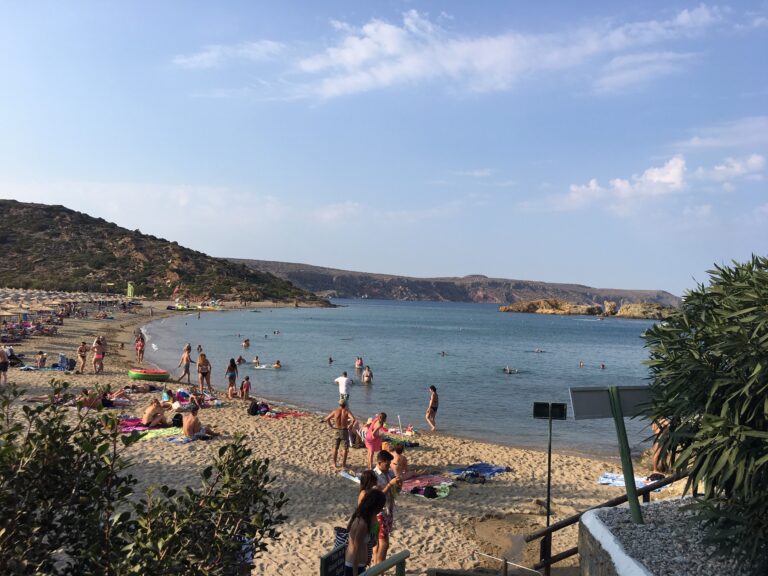
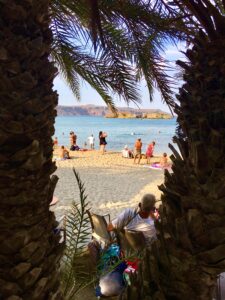
The beach was a wonderful time, with soft white sand, clear water, and sunshine galore, with a gorgeous palm forest stretched out behind me and to the left of me. I felt like I was becoming one with the beach as I let myself cook in the hot rays, and I wondered how feasible life would be as a tent-dwelling beach bum, when my musings were interrupted by my cousin handing me a banana. I was still skeptical of these bananas tasting anything other than how bananas normally taste, but I obliged him, and realized without question that I had tasted forbidden fruit. My cousin may have had a point when he told me I’d never had a decent one. These were sweeter than the bananas back home, so much so I’d almost classify them as being rich, and yet I felt refreshed after I ate them. They were the perfect complement to a day at the beach. They simply tasted like Summer.

I had to have more.

When we were packing up the car with our damp towels and beach covers, I asked my cousin if it wouldn’t be too much trouble to stop once more at the stand.

“I don’t know if he’ll have any left, it’s late in the day.”

I had not considered this, but by then my thoughts were consumed with the primal, caveman-like desire of “obtain more bananas.” I had to try, damn it. I had to try. My cousin shrugged, and two minutes later he once again pulled into the makeshift ‘parking lot’ of the fruit stand. I got out of the car with the desperation of someone trying to hurry up and abscond with the last bits of fruit in a shop’s possession while poorly disguising said desperation by trying and failing to check their speed. I glanced at the place where the bunches had been hanging before: success! There were two bunches left! I sped-walked over to the Banana Man, and asked him if it wouldn’t be too much trouble to buy his remaining stock.

“No, I can’t.”

I wondered if they had been sold, but the answer was…much more perplexing to me.

“I cannot sell them to other people if you buy. I lose money.”

In my mind came a flurry of thoughts that I had neither the ability or knowledge to convey. But if you sell all your bananas to me, you make the same amount of money that you were going to make if you sold them to other people. I just…I want to buy your bananas.

“Okay…can I have half of them?”

“Half?”

“Ah damn—can I take just these?” I said, gesturing to one bunch.

“No, I’m sorry. I need to sell to other people, or I make no money.”

But—but I’m still giving you the same—please just let me buy your bananas.

“Can I have three more bananas?”

He shook his head.

“Two more?”

He shook his head again, and I heard the desperation creep into my voice.

“One banana?”

You can probably guess how that ended. I looked around at the stretch of empty road, and at the only other people at the stand, a Dutch family that were examining some dragon fruit that quite frankly also looked just as good. But I couldn’t leave now. I couldn’t be thwarted by the Banana Man. How can you get a customer hooked on your product and then deny them another purchase? The gears in my head turned and clanked about as I tried desperately to string “γεια σας”, “Καλημέρα”, and “κοτόπουλο” into a sentence that would convey how badly I wanted, nay, needed, those bananas. But while I struggled and tried to make the pieces of this grammatical conundrum fit, the Dutch family glanced at, admired, and purchased the lovely bananas right out from under me, Banana Man smiling the entire time.

My eyes narrowed, my mouth opened just a tad, and in my mind, I could not help but wonder if it had indeed been personal. None of it mattered though. I was left banana-less, and, bereft, I turned back to the van, where my cousin looked at me, confused.

“I thought you were going to buy more?”

“I tried.”

“What do you mean?”

“He wouldn’t sell them to me. He said he would lose money if I bought them all because he couldn’t sell them to any other beach-goers.”

“Oh. Yeah, that makes sense.”

I couldn’t do anything but gape at him, so I did for a brief time, wondering just whose side my cousin was on here. We could be eating bananas right now. Beautiful, sweet, magical bananas. The best damn bananas in the world. And yet…here we were…empty-handed. And empty in soul. Had I made some sort of pact with an otherworldly banana salesman who operated on rules based in a supernatural plane and not our own? Was I now paying for my pride, my belief that bananas were nothing special, until some Greek trickster banana god thought I should be punished for my folly? Maybe. Probably. I like to think so.

So, if you’re planning on taking a trip to Vai, and you come across a lonely looking fruit stand of questionable integrity, with maybe three other people clustered around some bananas…make a stop. Buy some bananas. Enjoy them. And don’t, whatever you do, take them for granted.


By Katarina Kapetanakis

When my cousin told me, out of the blue, that he had found the best sushi I would ever taste, I did something many of you would consider to be…rude.

I laughed in his face.

After all, when I say the Greek islands, does Asian cuisine come to mind? No, it doesn’t! The kind of fish you’d find in the town of Heraklion is not the same style as that you’d find in Tokyo. Frankly I figured I wouldn’t taste anything but lamb, chicken, and gyros for several more weeks. I had planned to hit my favorite sushi restaurant the very day my plane would touch American soil again, where I would treat myself to salmon sashimi, a tuna tartar, maybe some tamago, and the like. I loved the Cretan palate, but I would be lying if I said I didn’t dream of the occasional volcano roll. So how could I expect the Greeks to enjoy the taste of raw fish, since every other restaurant I’d been to (though their fish was delicious), cooked theirs? I wasn’t under any impression that there was a market for sushi on Crete.

“Trust me. You’ve never had sushi like this.”

“I’ll believe it when I taste it,” I said.

My cousin didn’t seem to understand my skepticism. My siblings, who were just as Americanized as I, couldn’t understand how our cousin thought that he had found sushi on the island. My brother rolled his eyes and was ready to write off all my cousin’s protestations. My sister wanted to take the risk, but my brother and I figured this was due to a desperation for food that wasn’t lamb. Finally, our curiosity overcame our trepidation we had over trying whatever the Greeks thought sushi was, and we decided to call up our cousin and have ourselves a culinary escapade.

We drove about 45 minutes to the seaside town of Chersonissos (or Hersonissos, depending on who you ask), a place that, for me at least, reminded me a little of Hollywood beach in South Florida. For those that haven’t had the pleasure, picture a cozy but commercial seaside town, where the nightlife is more like a comfortable party than an all-out bacchanalia, where the restaurants all have gorgeous views of the sea, and people on motorcycles riding on paths that probably shouldn’t allow motorcycles, but do anyways. It’s a place that gives off a calm and pleasant atmosphere, one that satisfies anyone looking for a party while at the same time giving those who just want a nice dinner their space. Never had I seen the personification of a happy medium in a physical place. It was quite nice, and, as I was to learn, a greatly appropriate place for a sushi restaurant on a Greek island.

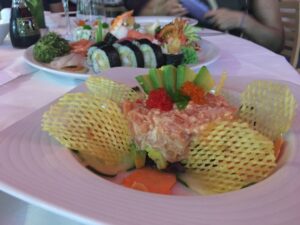
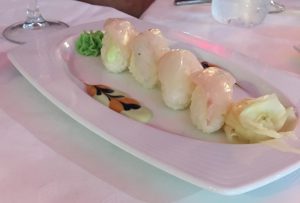
The restaurant is named Kymata Sushi, owned and run by a wonderful visionary named Christos, who was inspired while on business in Japan to bring the wonder of sushi to his home. His other profession, that of high-end jewelry store owner, has influenced his passion. The sushi he has helped to bring to this country is, quite simply, a work of art, as seen on the screens on the walls above the restaurant that show his beautiful jewelry morphing slowly into intricately rolled pieces of sushi. It was a little entrancing, and I couldn’t help but allow my mouth to water just a little.

“Wait until we order,” my brother said. “Just…wait.”

My brother takes his sushi very seriously. He can down four to five rolls of sushi (with some pieces of sashimi here and there) in the same time it takes a normal person to eat one roll with maybe an appetizer. It really is an impressive thing to witness, almost like a free Vegas magic show: watch this pound of tuna disappear before your eyes in 3…2…you get the point. His litmus test was a tad more precise than mine, and so we agreed to order a wide variety, to my cousin’s distress.

“Are you sure you’ll be able to eat all of that?” he asked, wondering just what we were feeding my brother in America, who was tall and thin and didn’t look as if he was physically capable of eating an entire kitchen. My brother’s face was stone. He wasn’t there to play games…he was there to eat sushi.

Our waiter took our order, and after some pleasant conversation with some of the staff and the owner, and some complimentary hors d’oeuvres, our sushi came. We think, in retrospect, that the waiters stuck around because they simply couldn’t believe my brother would be capable of eating, though a more realistic explanation is that they were the most attentive staff I’d seen in a while. I don’t think my water glass was emptied once that night.

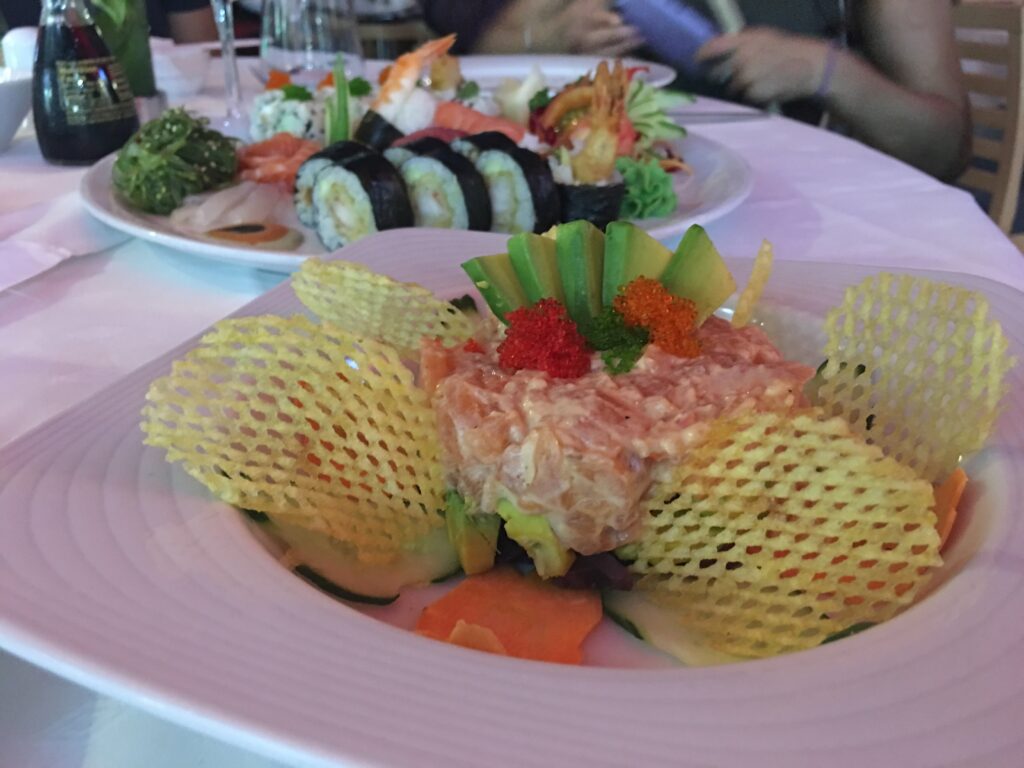
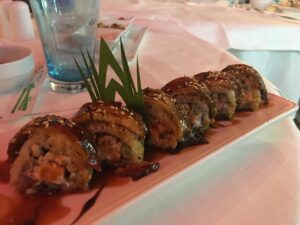
But the sushi was a marvel. It was beautifully presented, as if Poseidon himself had wrapped up his treasures and presented them to us on a plate. Our eyes wide, we couldn’t help but drool at the colorful array before us, filling the table, and making us just a little unsure of how much, in our hubris, we had ordered. The taste test, however, was still before us. We gazed at my brother, who had assumed the position of authority, and waited with bated breath as he lifted the first piece of sushi to his lips. The air went out of the restaurant. You could have heard a fish bone drop.

Our cousin, as you probably guessed, was right: the sushi was the most delicious we had ever tasted. My brother’s eyes rolled back into his head, enraptured, and my sister, usually a proponent of sharing from other people’s plates, decided to start hoarding her own. I had to confess to my cousin that we ugly Americans were eating our hats. This was, in fact, the best sushi I’d ever had, and my brother concurred. He devoured 30 pieces of sushi, 12 pieces of sashimi, and an entire bowl of salmon tartar. He thanked our cousin for showing us the restaurant, and then walked off into the night, his thirst for sushi officially quenched. What a hero.

So if you are searching for a break in between the traditional Cretan fare, look no further than the small, lively town of Chersonissos. Look for a clean, well-lit place, known as Kymata, and enjoy some of the best sushi you’ll ever have in your life.

Say hello to Christos for me.

By Katarina Kapetanakis 
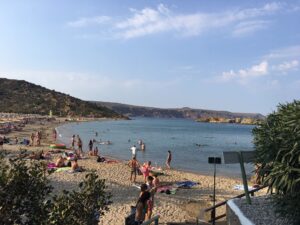
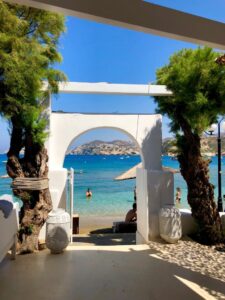
Many people come to Crete in search of the perfect beach experience, and they certainly will have no trouble finding options. That’s the beauty of an island vacation; every road leads to a cove, every path leads to a waterway, and every beach holds the promise of a good swim and plenty of sunshine. I’ve never been happier and more at peace than when I’m lying on the shores of a Cretan beach. The sound of the waves, the feeling of the sun baking my skin, the cool breeze that salves my budding sunburn, it all comes together to make up what is the highlight of my summers on the island. I’ve become something of a beach connoisseur during my time on Crete, and though there are almost too many beaches to choose as a favorite, Agia Pelagia has to be my number one pick.

Welcome to Agia Pelagia

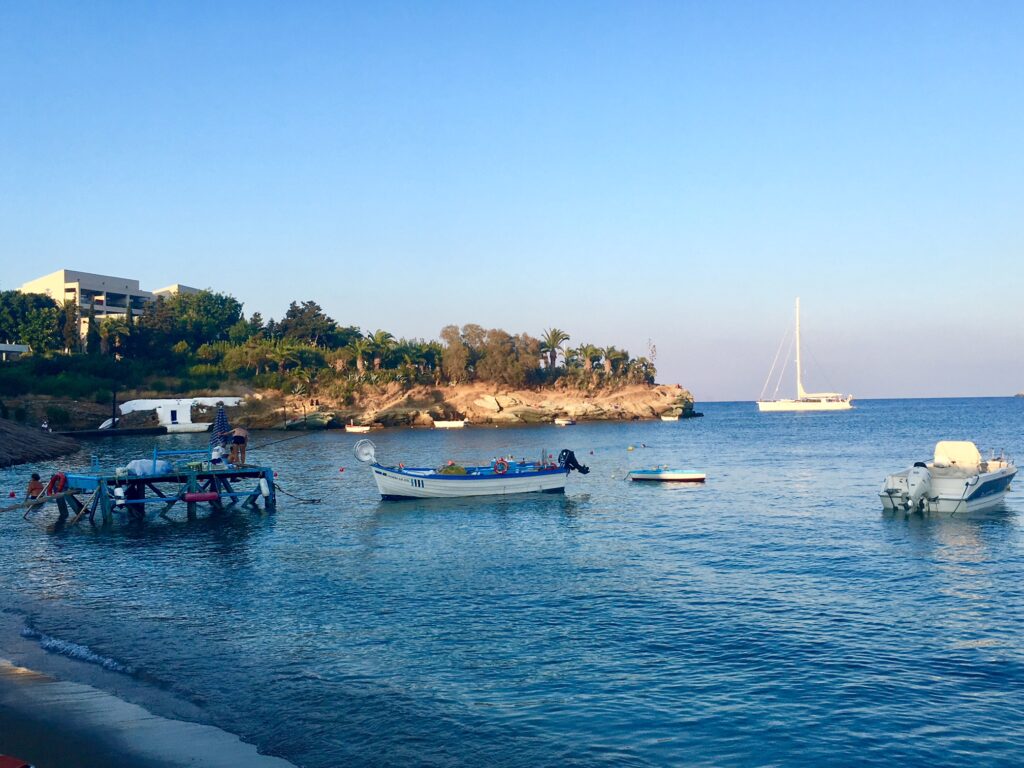
There are other beaches on the island that travel magazines or shows will highlight as being the beach-to-see, and I wouldn’t disagree with them. As a visitor to Crete, you should experience all of the wondrous beaches to see there. But Agia Pelagia is so often overlooked, I felt that I should highlight the beach that has brought me some of my happiest days. (And, it helps that Agia Pelagia is located only about ten to fifteen minutes away from all of the Wine Dark Villas).  Agia Pelagia isn’t necessarily a small beach, but it certainly isn’t a large one. The beach is nestled in a semi-circle of cliff-side, where the sun shines perfectly down into the center. The ocean here is calm, with a blue that rivals the clearest of sapphires, with waters so cool you’ll have forgotten whatever discomfort the sun has brought you up to then. The water of Agia Pelagia is like glass, so clear and beautiful that you’ll see every strange and colorful fish as they come to say hello, or perhaps to give a tentative nibble. Don’t worry, though: all these fish are quite small and quite harmless, and many are a marvel to look at!

One of my favorite things to do is to dive and explore the many boulders, crevices, and small caverns that lie on the bottom of the ocean there. With a good pair of goggles and an average swimming ability, you can explore a whole new underwater paradise, watching the fish dart in and out between the rocks, seeking out the hidden places where the sea urchins lurk, imagining that this world is one that you can be a part of. It is a dream under that water, and one you can prolong by hopping on a charter and scuba diving into deeper parts. If you’re the daring sort who prefers thrills to relaxation, there is a short but steep path, for those who aren’t near-sighted or those not surefooted, that leads to a ledge where natives and tourists alike leap into the sea. When you feel like emerging from the depths of the ocean, you can relax on one of the lounge chairs that they have set up for rent along the sandy beach. From there you can relax, sunbathe, or take refuge from the hot Cretan sun in the shade of the umbrellas, sipping on drinks from the café behind you.

The path to the diving ledge

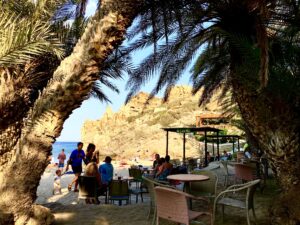
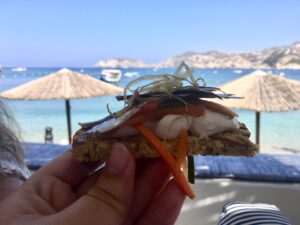
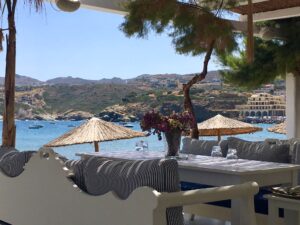
And speaking of that café, it’s worth noting that the taverna Almyra is the perfect place to get some lunch (or dinner) at Agia Pelagia. The taverna is split into two halves, the first half a sort of club where you can dance, drink, or lounge while you enjoy the day with your friends. The second half is an excellent taverna that is fairly quiet compared to the first half, with modern twists on Greek cuisine. From delicious freshly marinated anchovies mixed with fresh vegetables, tuna sashimi, unique takes on hummus and tzatziki alike, to traditional fare like lamb-chops and grilled salmon. Don’t let the twists on the cuisine fool you: the Cretan tradition of providing good food and hospitality runs strong in this little seaside taverna. But for all of this, my favorite thing about Almyra is how open this taverna is, and how all of the tables provide an excellent view of the beach. In fact, I highly recommend eating there come sundown; the sunsets at Agia Pelagia are so colorful and vibrant that they almost serve as a reminder to me of how rich and colorful life on the island of Crete can be, and how beautiful life can be all on its own.

Anchovies, anyone?

Coming to Agia Pelagia is the quintessential Cretan experience for me. It’s the escapism from the busy day-to-day, losing myself in the waves and the sand and the sun, letting nature work its healing wonders on my stressed mind. To be rejuvenated by the lovely Agia Pelagia is to be rejuvenated by the best of Crete, and I hope you take the time to experience this wonderful beach in all its glory. I will leave you with a thought by Cretan author Nikos Kazantzakis, who can sum up how I feel much more articulately than I: “I felt once more how simple and frugal a thing is happiness: a glass of wine, a roast chestnut, a wretched little brazier, the sound of the sea. Nothing else.”

By Katarina Kapetanakis